Back
BackTrade-offs, Comparative Advantage, and the Market System – Study Notes
Study Guide - Smart Notes
 Tailored notes based on your materials, expanded with key definitions, examples, and context.
Chapter 2: Trade-offs, Comparative Advantage, and the Market System
2.1 Production Possibilities Frontiers and Opportunity Costs
The Production Possibilities Frontier (PPF) is a fundamental model in economics that illustrates the trade-offs and opportunity costs faced by producers when allocating scarce resources between two goods. The PPF demonstrates the maximum attainable combinations of two products that can be produced with available resources and current technology.
Scarcity: The condition where unlimited wants exceed the limited resources available. Scarcity forces individuals, firms, and governments to make choices, leading to trade-offs.
Trade-off: Choosing more of one good or activity means having less of another due to limited resources.
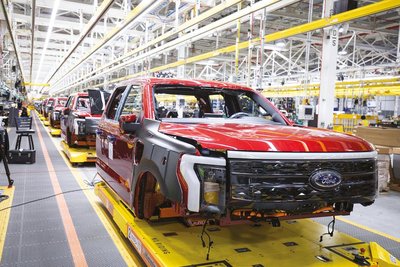
Opportunity Cost: The highest-valued alternative that must be given up to engage in an activity. For example, if Ford produces more electric vehicles, it must produce fewer gasoline-powered trucks.
PPF as a Positive Tool: The PPF shows "what is" (positive economics), not "what should be" (normative economics).
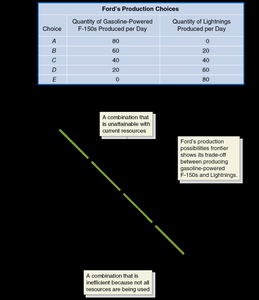
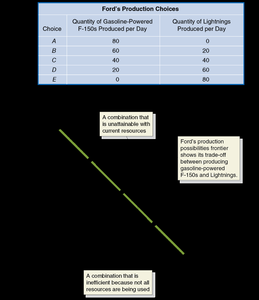
Points on the PPF: Attainable and efficient combinations of goods.
Points below the PPF: Inefficient use of resources.
Points above the PPF: Unattainable with current resources and technology.
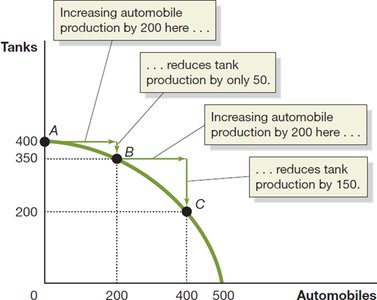
Constant vs. Increasing Opportunity Costs: If resources are equally suited for both goods, opportunity costs are constant (straight-line PPF). If not, opportunity costs increase as more resources are shifted (bowed-outward PPF).
Economic Growth: An outward shift of the PPF, representing an increase in an economy's capacity to produce goods and services. This can result from more resources or technological improvements.
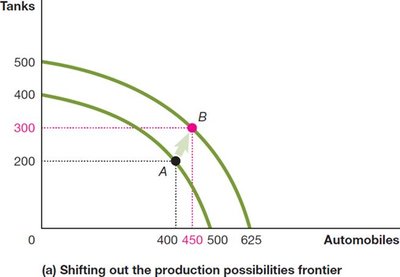
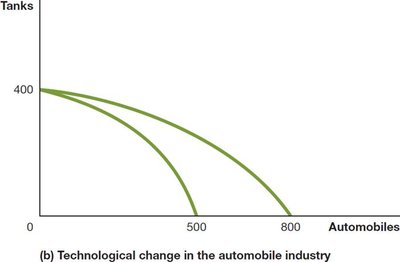
Example: Allocating study time between two exams results in a bowed-outward PPF, as the opportunity cost of focusing more on one subject increases.
2.2 Comparative Advantage and Trade
Comparative advantage is the foundation of trade. It explains how individuals, firms, or countries can benefit by specializing in the production of goods for which they have the lowest opportunity cost and trading for others.
Absolute Advantage: The ability to produce more of a good or service than competitors using the same amount of resources.
Comparative Advantage: The ability to produce a good or service at a lower opportunity cost than competitors.
Specialization: When each party specializes in the good for which they have a comparative advantage, total production and consumption increase through trade.
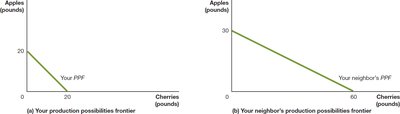
Example: If you and your neighbor each specialize (you in apples, your neighbor in cherries), and then trade, both can consume more than they could without trade.
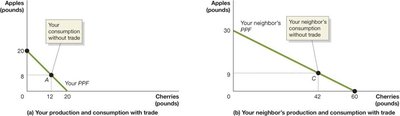
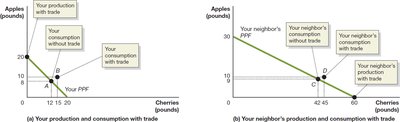
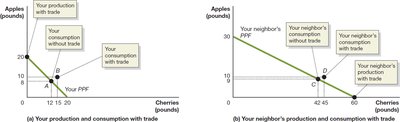
You: Apples (lbs) | You: Cherries (lbs) | Your Neighbor: Apples (lbs) | Your Neighbor: Cherries (lbs) | |
|---|---|---|---|---|
Production and consumption without trade | 8 | 12 | 9 | 42 |
Production with trade | 20 | 0 | 0 | 60 |
Consumption with trade | 10 | 15 | 10 | 45 |
Gains from trade (increased consumption) | 2 | 3 | 1 | 3 |
Opportunity Cost Table:
Opportunity Cost of 1 lb Apples | Opportunity Cost of 1 lb Cherries | |
|---|---|---|
You | 1 lb cherries | 1 lb apples |
Your Neighbor | 2 lbs cherries | 0.5 lb apples |
Application: Comparative advantage can be used to divide household chores efficiently, even if one person is better at both tasks.
2.3 The Market System
The market system is the institutional arrangement through which buyers and sellers interact to exchange goods, services, and resources. It relies on the decentralized decisions of households and firms, coordinated by prices and markets.
Market: A group of buyers and sellers of a good or service and the institution or arrangement by which they come together to trade.
Households: Provide factors of production (labor, capital, natural resources, entrepreneurial ability).
Firms: Purchase factors of production from households and use them to produce goods and services.
Factors of Production:
Labor: All types of work.
Capital: Physical capital like machinery, buildings, and tools.
Natural Resources: Land, water, minerals, etc.
Entrepreneurial Ability: The skill to bring together the other factors to produce goods and services.
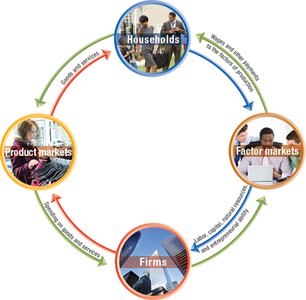
Households | Firms | |
|---|---|---|
What they sell | Factors of production to firms in factor markets | Goods and services to households in product markets |
What they buy | Goods and services from firms in product markets | Factors of production from households in factor markets |
Factor Market: Where factors of production are bought and sold.
Product Market: Where goods and services are bought and sold.
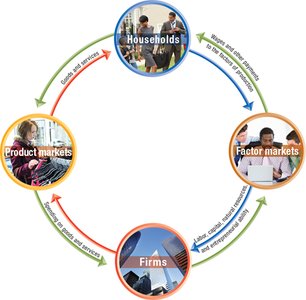
Circular-Flow Diagram: Illustrates the flow of resources, goods and services, and money in an economy. It is a simplified model, omitting government, financial systems, and foreign trade (to be covered in later chapters).
The Gains from Free Markets
Free Market: An economic system with few government restrictions on production, sale, or employment of resources.
Historically, countries with freer markets have achieved higher living standards than those with centrally planned economies.
Adam Smith: Advocated for free markets in "The Wealth of Nations" (1776), introducing the concept of the "invisible hand"—the idea that individual self-interest in a market economy leads to outcomes that benefit society as a whole.
The Market Mechanism
Markets coordinate the actions of households and firms through price signals.
Flexible prices allow resources to be allocated efficiently, responding to changes in consumer preferences and technology.
Example: If demand for electric cars rises, firms increase production to capture higher profits, reallocating resources without central direction.
How the Market Mobilizes Knowledge
Markets process vast amounts of information, much of it local and specific to individuals or firms.
Decentralized decision-making allows for rapid adaptation to changing conditions, unlike centrally planned economies.
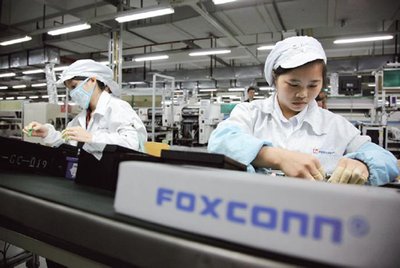
Example: The production of an iPad involves hundreds of firms worldwide, coordinated by market incentives rather than central planning.
The Role of the Entrepreneur in the Market System
Entrepreneur: An individual who organizes the factors of production to create goods and services, often taking on significant risk.
Entrepreneurs drive innovation and economic growth by introducing new products and processes.
Example: Henry Ford revolutionized transportation with the automobile, not by improving horses but by creating something entirely new.
The Legal Basis of a Successful Market System
Even in free markets, government plays a crucial role in establishing the legal framework necessary for markets to function:
Protection of Private Property: Ensures individuals and firms have the incentive to work, invest, and innovate.
Property Rights: The right to exclusive use, including buying and selling property.
Enforcement of Contracts: Reliable legal systems are essential for long-term transactions and economic stability.
Apply the Concept: What Is Socialism?
Socialism (Marxist tradition): Advocates for collective or government ownership of the means of production.
Modern social democratic parties often support a larger government role in the economy, including ownership or regulation of key industries, but not full socialism.
Debate continues over the appropriate balance between market freedom and government intervention, especially in sectors like health care and education.