 Back
BackUnderstanding Marginal Opportunity Cost on a Production Possibilities Frontier
Study Guide - Smart Notes
 Tailored notes based on your materials, expanded with key definitions, examples, and context.
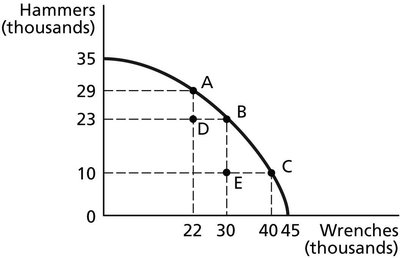
Q33. If the economy is currently producing at point A, what is the marginal opportunity cost of moving to point B?
Background
Topic: Production Possibilities Frontier (PPF) and Opportunity Cost
This question tests your understanding of how to calculate the marginal opportunity cost when moving between points on a PPF. The PPF shows the maximum possible output combinations of two goods that can be produced given available resources and technology.
Key Terms and Formulas
Marginal Opportunity Cost: The amount of one good that must be given up to produce an additional unit of another good.
Production Possibilities Frontier (PPF): A curve showing the maximum attainable combinations of two products that may be produced with available resources.
Formula:
Step-by-Step Guidance
Identify the coordinates for points A and B on the PPF. For example, point A might represent (22, 35) and point B (30, 29), where the first value is wrenches (thousands) and the second is hammers (thousands).
Calculate the change in the number of wrenches produced when moving from A to B: .
Calculate the change in the number of hammers produced when moving from A to B: .
Since producing more wrenches means producing fewer hammers, the opportunity cost is the decrease in hammers per increase in wrenches.
Set up the marginal opportunity cost formula: .
Try solving on your own before revealing the answer!
Final Answer: Marginal opportunity cost = -0.75 hammers per wrench
This means for each additional wrench produced, 0.75 hammers must be given up.
