 Back
BackUnemployment and Inflation: Key Concepts and Measurement in Macroeconomics
Study Guide - Smart Notes
 Tailored notes based on your materials, expanded with key definitions, examples, and context.
Unemployment and Inflation
Introduction
Unemployment and inflation are two of the most important macroeconomic indicators used to assess the health of an economy. Understanding how they are measured, their types, causes, and effects is essential for analyzing economic performance and policy decisions.
Measuring Unemployment
Definitions and Key Measures
Unemployment Rate: The percentage of the labor force that is unemployed. Calculated as:
Labor Force Participation Rate: The percentage of the working-age population in the labor force.
Employment-Population Ratio: The percentage of the working-age population that is employed.
The U.S. Bureau of Labor Statistics (BLS) uses the Current Population Survey (household survey) and the establishment (payroll) survey to collect employment data.
Problems with Measuring Unemployment
Discouraged Workers: Individuals not actively seeking work are not counted as unemployed, which can understate unemployment during recessions.
Part-Time Workers: People working part-time for economic reasons are counted as employed, even if they prefer full-time work.
Survey Limitations: Self-reported data may be inaccurate due to misreporting or unverified claims.
Unemployment Rates for Different Groups
Unemployment rates vary by race, education, and age. For example, in June 2023, Whites and college graduates had lower unemployment rates than African Americans and high school dropouts.
Trends in Labor Force Participation
The labor force participation rate for men has declined since 1948, while it increased for women until 1999 and then declined slightly.
Overall participation rates are influenced by demographic changes, such as aging populations and social trends.
Job Creation and Destruction
The economy constantly creates and destroys jobs due to technological change, consumer preferences, and business cycles.
Employment-Population Ratio as a Labor Market Indicator
The employment-population ratio is often considered a better indicator of labor market health than the unemployment rate, as it is less affected by discouraged workers leaving the labor force.
Types of Unemployment
Frictional Unemployment
Short-term unemployment from the process of matching workers with jobs.
Includes seasonal unemployment due to predictable fluctuations (e.g., tourism, agriculture).
Structural Unemployment
Results from a persistent mismatch between workers' skills and job requirements.
Often requires retraining or relocation and can last longer than frictional unemployment.
Cyclical Unemployment
Caused by economic downturns (recessions) when demand for goods and services falls.
Natural Rate of Unemployment
The sum of frictional and structural unemployment; also called the full-employment rate of unemployment.
Explaining Unemployment
Government Policies
Unemployment Insurance: Provides income support but may increase the duration of unemployment by reducing the urgency to find new work.
Minimum Wage Laws: If set above market equilibrium, can increase unemployment among low-skilled workers.
Labor Unions: Can raise wages above market levels in unionized sectors, but overall effect on unemployment is limited due to low unionization rates.
Efficiency Wages: Firms may pay above-market wages to boost productivity, which can also increase unemployment if not all workers can find such jobs.
Measuring Inflation
Price Level and Inflation Rate
Price Level: The average of current prices across the entire spectrum of goods and services produced in the economy.
Inflation Rate: The percentage increase in the price level from one year to the next.
Consumer Price Index (CPI)
Measures the average price paid by urban consumers for a fixed basket of goods and services.
Used for cost-of-living adjustments and as a key indicator of inflation.
Subject to biases: substitution, quality changes, new products, and outlet substitution.
Producer Price Index (PPI)
Measures average changes in prices received by domestic producers for their output.
Can signal future changes in consumer prices.
Using Price Indexes to Adjust for Inflation
Nominal vs. Real Variables
Nominal Variable: Measured in current dollars (not adjusted for inflation).
Real Variable: Adjusted for inflation using a price index.
Nominal Interest Rates vs. Real Interest Rates
Nominal Interest Rate: The stated rate on a loan or investment.
Real Interest Rate: The nominal rate adjusted for inflation.
Real interest rates provide a better measure of the true cost of borrowing and the real return to lending.
Does Inflation Impose Costs on the Economy?
Costs of Anticipated Inflation
Menu costs: The costs to firms of changing prices.
Increased tax burdens due to taxation of nominal rather than real returns.
Redistribution of income if wages or contracts do not keep up with inflation.
Costs of Unanticipated Inflation
Unexpected redistribution of income between borrowers and lenders.
Uncertainty in long-term contracts and investments.
Labor Market Trends and the Employment-Population Ratio
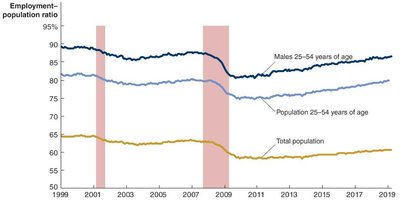
The employment-population ratio provides insight into the proportion of the population that is employed, which is especially useful during periods of economic change or recovery. The ratio can be analyzed for different demographic groups, such as prime-age workers (25–54 years old) and males in that age group.
Business Cycles and Labor Market Indicators
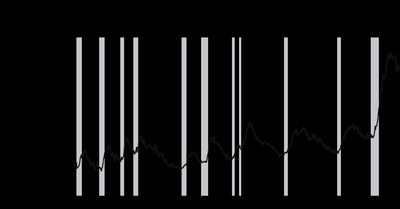
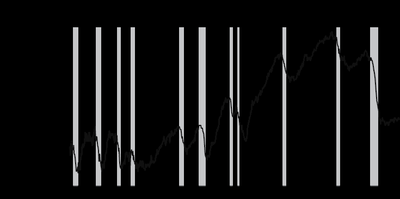
Business cycles—periods of economic expansion and contraction—affect both unemployment and employment-population ratios. During recessions (shaded areas in the graphs), unemployment rises and employment-population ratios fall. The recovery period may see slow improvements in these indicators, as observed after the 2007–2009 recession.
Summary Table: Types of Unemployment
Type | Definition | Duration | Main Cause |
|---|---|---|---|
Frictional | Short-term, matching workers with jobs | Short | Job search, transitions |
Structural | Mismatch between skills and jobs | Medium to long | Technological change, industry shifts |
Cyclical | Due to economic downturns | Variable | Business cycles |
Key Formulas
Unemployment Rate:
Labor Force Participation Rate:
Employment-Population Ratio:
Inflation Rate (using CPI):
Real Value:
Real Interest Rate:
Additional info: The employment-population ratio is increasingly used by economists as a robust indicator of labor market health, especially when labor force participation fluctuates due to demographic or economic shocks. Policy debates often focus on how to increase this ratio to boost economic growth and living standards.
