 Back
BackUnemployment and Inflation: Measurement, Types, and Economic Impacts
Study Guide - Smart Notes
 Tailored notes based on your materials, expanded with key definitions, examples, and context.
Unemployment and Inflation
Introduction
This chapter explores two central macroeconomic indicators: unemployment and inflation. Understanding how these are measured, their types, and their effects on the economy is essential for analyzing economic performance and policy.
Measuring Unemployment
Key Labor Market Indicators
Economists use several indicators to assess the labor market:
Unemployment Rate: The percentage of the labor force that is unemployed.
Labor Force Participation Rate: The percentage of the working-age population in the labor force.
Employment-Population Ratio: The percentage of the working-age population that is employed.
The U.S. Department of Labor, through the Bureau of Labor Statistics (BLS), regularly reports these statistics using surveys.
The Household Survey (Current Population Survey)
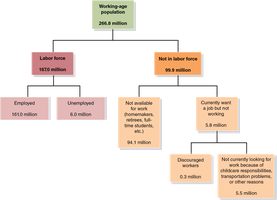
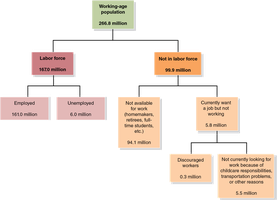
The BLS classifies individuals as:
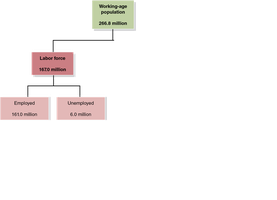
Employed: Currently working or temporarily absent from a job.
Unemployed: Not working but available and actively seeking work in the past four weeks.
Not in the Labor Force: Neither employed nor actively seeking work.
Discouraged Workers: Available for work but not seeking due to belief that no jobs are available.
Calculating Labor Market Indicators
Unemployment Rate:
Labor Force Participation Rate:
Employment-Population Ratio:
Limitations of the Unemployment Rate
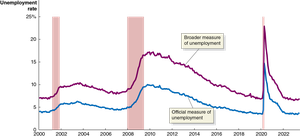
May understate unemployment by excluding discouraged workers and underemployed individuals (those working part-time but seeking full-time work).
May overstate unemployment if people falsely claim to be seeking work.
The BLS also reports a broader measure (U-6) that includes discouraged and underemployed workers.
Unemployment Rate Variations
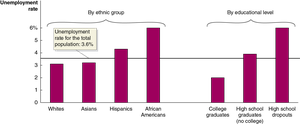
Unemployment rates differ by ethnic group and education level.
Higher education is generally associated with lower unemployment rates.
Trends in Labor Force Participation
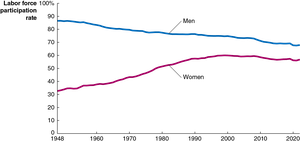
Participation rates for men have declined since 1948, while rates for women increased significantly until recently.
The Establishment Survey (Payroll Survey)
Surveys businesses about their employees.
Excludes self-employed and new firms; measures employment, not unemployment.
Provides payroll-based data, reducing self-reporting bias.
Labor Market Data During the Covid-19 Pandemic
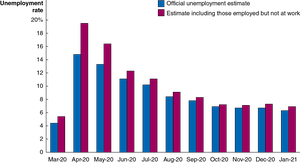
Classification issues arose: many were counted as "employed but absent from work" rather than unemployed.
Seasonal adjustments became more difficult due to uneven sector impacts.
Job Creation and Destruction
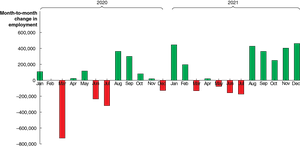
Millions of jobs are created and destroyed annually, reflecting a dynamic labor market.
BLS reports net changes, but gross flows are much larger.
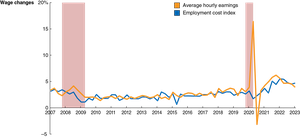
Measuring Changes in Wages
Average Hourly Earnings (AHE): Measures wage trends.
Employment Cost Index (ECI): Includes wages and benefits, adjusted for occupational mix.
Types of Unemployment
Three Main Types
Frictional Unemployment: Short-term, due to job search or transitions (e.g., new entrants, seasonal jobs).
Structural Unemployment: Persistent mismatch between worker skills and job requirements; may require retraining.
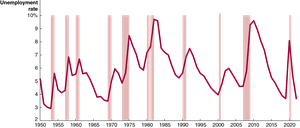
Cyclical Unemployment: Caused by economic downturns (recessions).
Natural Rate of Unemployment
Consists of frictional and structural unemployment.
Represents "full employment" (typically 4–5% in the U.S.).
Technological Change and Structural Unemployment
Advances in technology (e.g., automation, AI) can increase structural unemployment by making some skills obsolete.

Explaining Unemployment
Government Policies
Programs like Trade Adjustment Assistance and hiring subsidies can reduce structural and frictional unemployment.
Unemployment insurance and minimum wage laws may increase unemployment by reducing incentives to accept lower-paying jobs or by raising labor costs.
Unemployment Insurance
Provides temporary income to unemployed workers, allowing more time for job search.
More generous benefits are associated with higher unemployment rates (notably in Western Europe).
Minimum Wage Laws
Set a legal floor for wages; can reduce employment among low-skilled workers, especially teenagers.
Overall effect on unemployment is small at current U.S. levels.
Labor Unions
Bargain for higher wages and better conditions; limited impact on overall unemployment due to low unionization rates in the private sector.
Efficiency Wages
Firms may pay above-market wages to boost productivity and reduce turnover, potentially increasing unemployment if more people seek these jobs than are available.
Measuring Inflation
Price Level and Inflation Rate
Price Level: Average of current prices across the entire economy.
Inflation Rate: Percentage increase in the price level from one year to the next.
Common Price Indexes
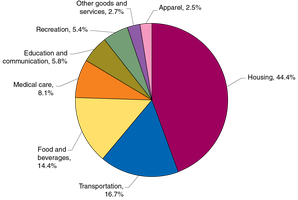
Consumer Price Index (CPI): Measures average prices paid by urban consumers for a fixed basket of goods and services.
Producer Price Index (PPI): Measures average prices received by producers at all stages of production.
Calculating the CPI
Choose a basket of goods and services.
Determine the cost of the basket in the base year and the current year.
Calculate CPI:
The inflation rate is then:
Limitations of the CPI
Substitution Bias: Consumers may switch to cheaper alternatives as prices change.
Quality Change Bias: Difficult to separate price increases from quality improvements.
New Product Bias: Delay in including new goods in the basket.
Outlet Bias: Changes in where consumers shop (e.g., discount stores, online).
Economists estimate the CPI overstates inflation by 0.5 to 1 percentage point.
Producer Price Index (PPI)
Tracks prices of goods at various production stages (raw materials, intermediate, finished goods).
Often signals future changes in consumer prices.
Using Price Indexes to Adjust for Inflation
Adjusting Dollar Values Over Time
To compare monetary values across years, adjust for inflation using the CPI:
This allows for meaningful comparisons of purchasing power over time.
Nominal vs. Real Variables
Nominal Variables: Measured in current dollars (not adjusted for inflation).
Real Variables: Adjusted for inflation, reflecting true purchasing power.
Nominal Interest Rates vs. Real Interest Rates
Definitions and Calculation
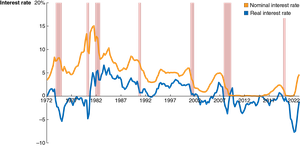
Nominal Interest Rate: The stated rate on a loan or investment.
Real Interest Rate: Adjusted for inflation; approximated as:
Does Inflation Impose Costs on the Economy?
Problems with Inflation
Not all prices and wages rise at the same rate, causing changes in real income and purchasing power.
People on fixed incomes are especially vulnerable to inflation.
Anticipated vs. Unanticipated Inflation
Anticipated Inflation: Still causes costs (menu costs, shoe-leather costs, tax distortions, and income redistribution).
Unanticipated Inflation: Increases uncertainty, making borrowing and lending riskier and potentially leading to inefficient contracts.
Distributional Effects of Inflation
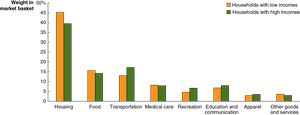
Inflation can affect different income groups differently, depending on their spending patterns and wage growth.
Recent data show that high inflation in certain goods (e.g., cars) affected higher-income households more, while wage growth for lower-income workers sometimes outpaced inflation.
Additional info: The chapter also discusses the importance of accurate measurement and the limitations of labor market and inflation statistics, especially during unusual economic events such as the Covid-19 pandemic.
