 Back
BackUnemployment: Concepts, Measurement, and Trends
Study Guide - Smart Notes
 Tailored notes based on your materials, expanded with key definitions, examples, and context.
Unemployment: Concepts, Measurement, and Trends
Key Unemployment Terms
Understanding unemployment requires familiarity with several key terms used in government statistics and economic analysis.
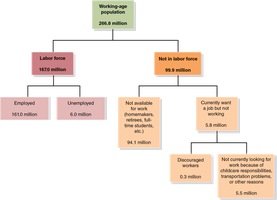
Employed: Individuals who currently have a job or are temporarily away from their job.
Unemployed: Individuals without a job who are available for work and have actively looked for work in the previous month.
Labor Force: The sum of employed and unemployed workers in the economy.
Discouraged Workers: People available for work but who have not looked for a job in the past four weeks because they believe no jobs are available for them.
Natural Rate of Unemployment: The sum of structural and frictional unemployment, often referred to as full employment. In the U.S., this rate is typically between 4-5%.
Measuring Unemployment
Unemployment is measured using data collected by the Bureau of Labor Statistics (BLS). The most common measure is the unemployment rate, formally known as BLS series U-3.
Unemployment Rate Formula:
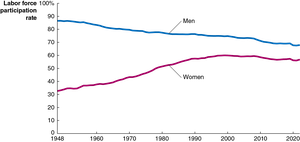
Labor Force Participation Rate: The percentage of the working-age population in the labor force.
Broader Measures of Unemployment
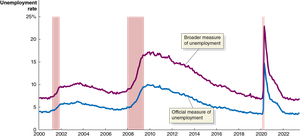
Some economists argue for broader measures of unemployment that include discouraged workers and underemployed workers. The BLS provides such a measure, known as BLS series U-6.
Official Unemployment Rate (U-3): Includes only those actively seeking work.
Broader Unemployment Rate (U-6): Includes discouraged workers and those working part-time for economic reasons.
Trends in Labor Force Participation
Labor force participation rates have changed over time, with notable differences between men and women. Since 1948, participation among adult men has declined, while participation among adult women increased significantly before recently declining.
Types of Unemployment
Unemployment can be classified into three main types, each with distinct causes and implications:
Frictional Unemployment: Occurs when people move between jobs or enter the labor force for the first time. It is considered natural and beneficial, as it allows for job matching.
Structural Unemployment: Results from changes in consumer demand or technology, leading to a mismatch between workers' skills and available jobs. This type is usually of longer duration.
Cyclical Unemployment: Caused by downturns in the business cycle, such as recessions, when economic activity slows and jobs are lost.
Example Classification:
A computer programmer laid off due to a recession: Cyclical unemployment
A literary editor moving to a new city for work: Frictional unemployment
An assembly-line worker replaced by technology: Structural unemployment
Natural Rate of Unemployment
The natural rate of unemployment is the level at which the economy is considered to be at full employment. It consists of frictional and structural unemployment, with cyclical unemployment at zero.
Normal rate: Frictional + Structural unemployment
Full employment: No cyclical unemployment
Government Policies and Unemployment Insurance
Unemployment insurance and other government payments help mitigate the effects of unemployment. In the U.S., unemployment insurance typically covers about half the average wage, helping maintain income and spending during job loss and reducing the severity of recessions.
Purpose: Reduce personal hardship and stabilize the economy during downturns.
Unemployment and Economic Well-being
Economists sometimes use the misery index, which adds the inflation rate and unemployment rate, to gauge the overall state of the economy. High unemployment rates, especially during recessions, can influence career decisions and economic policy.
Misery Index Formula:
Unemployment Rates by Demographics
Unemployment rates vary by ethnic group and education level, reflecting broader social and economic factors. These differences are statistically related and important for understanding labor market dynamics.
Youth Unemployment in G20 Countries
Youth unemployment rates are often higher than overall rates, especially in certain countries. This reflects challenges faced by young people entering the labor market.
Summary Table: Types of Unemployment
Type | Cause | Duration | Example |
|---|---|---|---|
Frictional | Job transitions, new entrants | Short | College graduate seeking first job |
Structural | Technological change, shifts in demand | Long | Assembly-line worker replaced by automation |
Cyclical | Business cycle downturns | Variable | Layoffs during recession |
Additional info: The notes expand on brief points with academic context, definitions, and examples to ensure completeness and clarity for exam preparation.
