 Back
BackUnemployment, Inflation, and Long-Run Growth: Key Concepts in Macroeconomics
Study Guide - Smart Notes
 Tailored notes based on your materials, expanded with key definitions, examples, and context.
Unemployment, Inflation, and Long-Run Growth
Introduction
This chapter explores three fundamental macroeconomic topics: unemployment, inflation, and long-run economic growth. Understanding these concepts is essential for analyzing the health and performance of an economy over time.
Unemployment
Measuring Unemployment
Unemployment is a key indicator of economic performance. The U.S. Bureau of Labor Statistics (BLS) regularly reports on the labor market using several important definitions and formulas:
Employed: Individuals 16 years or older who work for pay (at least 1 hour per week), work without pay in a family business (15+ hours per week), or have a job but are temporarily absent.
Unemployed: Individuals 16 years or older who are not working, are available for work, and have actively sought employment in the past 4 weeks.
Not in the labor force: Individuals not seeking work, either by choice or discouragement.
Labor force: The sum of employed and unemployed individuals.
Key Formulas:
Labor Force:
Population:
Unemployment Rate:
Labor Force Participation Rate:
Unemployment Rates by Demographic Group
Unemployment rates can vary significantly across demographic groups, such as age, gender, and race. For example, youth and minority groups often experience higher unemployment rates than the general population.
Discouraged-Worker Effect
The discouraged-worker effect occurs when individuals stop looking for work due to repeated failure, causing the measured unemployment rate to decline even though joblessness remains high. Including discouraged workers in unemployment statistics can provide a more accurate picture of labor market conditions.
Types of Unemployment
Frictional Unemployment: Short-term unemployment due to normal labor market turnover and job matching.
Structural Unemployment: Unemployment resulting from changes in the economy that eliminate certain jobs or industries.
Cyclical Unemployment: Unemployment above the natural rate, typically caused by economic downturns.
Natural Rate of Unemployment: The sum of frictional and structural unemployment, representing the baseline level in a healthy economy.
Social and Economic Costs of Unemployment
Unemployment can lead to loss of income, reduced economic output, and social problems such as poverty and decreased well-being.
The effects are not evenly distributed; some groups are more vulnerable than others.
Inflation and Deflation
Measuring Inflation
Inflation is the sustained increase in the general price level of goods and services. The main tools for measuring inflation are:
Consumer Price Index (CPI): Measures the average change in prices paid by urban consumers for a fixed basket of goods and services.
Producer Price Indexes (PPIs): Track prices received by producers at various stages of production.
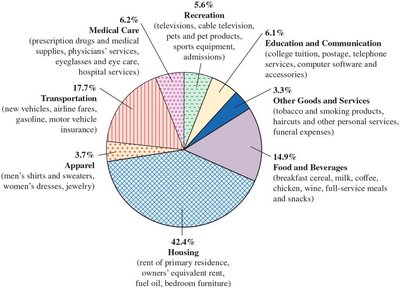
The CPI market basket reflects typical consumer spending patterns, with the largest shares allocated to housing, transportation, and food and beverages.
Trends in Inflation
Inflation rates fluctuate over time due to economic conditions, policy changes, and external shocks. Historical data show periods of both high inflation (e.g., 1970s) and low or negative inflation (deflation).
Costs and Effects of Inflation
Inflation can erode purchasing power if wages do not keep pace with rising prices.
Anticipated inflation allows for adjustments, but unanticipated inflation can redistribute income between borrowers and lenders.
Real Interest Rate:
Administrative costs and inefficiencies may arise from the need to frequently update prices and contracts.
Deflation
Deflation, or a general decline in prices, can also have significant economic effects. Unexpected deflation benefits borrowers but harms lenders and can increase the real burden of debt.
Long-Run Growth
Measuring Economic Growth
Output Growth: The rate at which the total output (GDP) of an economy increases over time.
Per-Capita Output Growth: The rate at which output per person increases, reflecting improvements in living standards.
Productivity Growth: The rate at which output per worker increases, often driven by technological progress and capital accumulation.
Trends in Productivity and Capital
Productivity grew rapidly in the 1950s and 1960s, then slowed in subsequent decades.
Capital per worker increased until about 1980, after which growth leveled off.
Key Terms and Concepts
Consumer Price Index (CPI)
Cyclical Unemployment
Discouraged-Worker Effect
Employed
Frictional Unemployment
Labor Force
Labor Force Participation Rate
Natural Rate of Unemployment
Not in the Labor Force
Output Growth
Per-Capita Output Growth
Producer Price Indexes (PPIs)
Productivity Growth
Real Interest Rate
Structural Unemployment
Unemployed
Unemployment Rate
Summary Table: Labor Market and Inflation Formulas
Concept | Formula (LaTeX) |
|---|---|
Labor Force | |
Population | |
Unemployment Rate | |
Labor Force Participation Rate | |
Real Interest Rate |
Additional info: The notes above expand on the provided slides and tables, offering definitions, formulas, and context for each major concept. The included image (CPI market basket) visually reinforces the explanation of how the CPI is constructed and why it is important for measuring inflation.
