 Back
BackChapter 1: Introduction to Managerial Accounting – Study Notes
Study Guide - Smart Notes
 Tailored notes based on your materials, expanded with key definitions, examples, and context.
Introduction to Managerial Accounting
Definition and Purpose of Managerial Accounting
Managerial accounting is a branch of accounting focused on providing information to internal decision makers, such as managers, to assist in planning, directing, and controlling business operations. Unlike financial accounting, which serves external users, managerial accounting is tailored to the needs of the organization’s management.
Managerial Accounting: Provides relevant information for internal decision making, including budgeting, performance evaluation, and cost management.
Financial Accounting: Focuses on preparing financial statements for external users such as investors, creditors, and regulatory agencies.
Key Users: Managers at all levels within the organization.
Example: A production manager uses managerial accounting reports to determine the cost of manufacturing a product and to identify areas for cost reduction.
Managers’ Role in the Organization
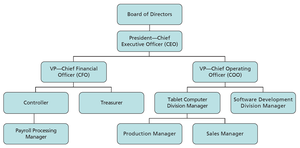
Managers operate at various levels and departments within a company, each with specific responsibilities. The organizational structure is often depicted in an organizational chart, which clarifies reporting relationships and managerial responsibilities.
Board of Directors: Elected by shareholders to set strategic goals.
Chief Executive Officer (CEO): Responsible for implementing company plans.
Line Positions: Directly involved in producing goods or services.
Staff Positions: Support line positions with specialized services.
Managerial Accounting Functions
Managerial accounting supports three primary management functions:
Planning: Setting goals and determining how to achieve them (strategic and operational planning).
Directing: Overseeing day-to-day operations to ensure plans are implemented effectively.
Controlling: Monitoring operations and making adjustments to stay on track toward goals.
Ethical Standards in Managerial Accounting
Managerial accountants are expected to uphold high ethical standards as outlined by the Institute of Management Accountants (IMA). These standards include:
Competence: Maintain professional expertise and perform duties in accordance with laws and standards.
Confidentiality: Protect sensitive information and use it appropriately.
Integrity: Avoid conflicts of interest and act honestly.
Credibility: Communicate information fairly and objectively.
Example: If asked to manipulate financial results, an accountant should refuse and report the issue according to company policy and professional guidelines.
Classification of Costs in Managerial Accounting
Types of Companies and Inventories
Companies are classified based on their primary activities:
Service Companies: Sell time, skill, and knowledge; do not carry inventory.
Merchandising Companies: Buy and resell finished goods; carry merchandise inventory.
Manufacturing Companies: Convert raw materials into finished products; maintain three types of inventory:
Raw Materials Inventory (RM): Materials awaiting use in production.
Work-in-Process Inventory (WIP): Goods in production but not yet complete.
Finished Goods Inventory (FG): Completed products ready for sale.
Direct and Indirect Costs
Costs are classified based on their traceability to a cost object (anything for which a separate cost measurement is desired):
Direct Costs: Easily traced to a cost object (e.g., direct materials, direct labor).
Indirect Costs: Cannot be easily traced to a cost object (e.g., manufacturing overhead).
Manufacturing Costs
Manufacturing costs are divided into three categories:
Direct Materials (DM): Raw materials directly used in production.
Direct Labor (DL): Wages of employees who physically convert materials into finished products.
Manufacturing Overhead (MOH): All other manufacturing costs (indirect materials, indirect labor, factory expenses).
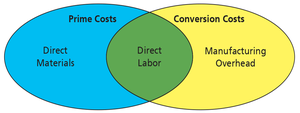
Prime and Conversion Costs
Manufacturing costs can also be grouped as:
Prime Costs: Direct materials + direct labor.
Conversion Costs: Direct labor + manufacturing overhead.
Product and Period Costs
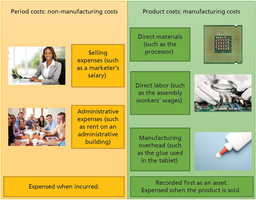
Costs are also classified by when they are expensed:
Product Costs: Costs incurred to manufacture a product (DM, DL, MOH); recorded as inventory until the product is sold.
Period Costs: Non-manufacturing costs (selling, administrative, taxes, interest); expensed in the period incurred.
Financial Statements for Manufacturing Companies
Balance Sheet
The balance sheet for manufacturing companies includes three inventory accounts: Raw Materials, Work-in-Process, and Finished Goods. Service companies do not report inventory, while merchandising companies report Merchandise Inventory.
Income Statement
Manufacturing and merchandising companies report Cost of Goods Sold (COGS) as a major expense. For manufacturers, COGS is calculated using the cost of goods manufactured and changes in finished goods inventory.
Schedule of Cost of Goods Manufactured
The schedule of cost of goods manufactured summarizes the production costs for the period and is used to calculate COGS. The calculation involves three steps:
Calculate direct materials used.
Calculate total manufacturing costs incurred.
Calculate cost of goods manufactured.
Formula for Cost of Goods Manufactured:
Business Trends Affecting Managerial Accounting
Key Trends
Modern managerial accounting is influenced by several business trends:
Shift to Service Economy: Increased focus on service-based businesses.
Global Competition: Companies must compete internationally.
Time-Based Competition: Use of Enterprise Resource Planning (ERP) systems and Just-in-Time (JIT) inventory management.
Advances in Technology: Automation and data analytics are transforming accounting practices.
Total Quality Management (TQM) and the Value Chain
Total Quality Management is a philosophy of continuous improvement, emphasizing the value chain—each step in the process adds value to the final product.
The Triple Bottom Line
Companies are increasingly evaluated on their economic, social, and environmental impact—referred to as the triple bottom line: profits, people, and planet.
Managerial Accounting in Service and Merchandising Companies
Application in Different Sectors
Managerial accounting helps managers in service and merchandising companies make informed decisions about pricing, cost control, and profitability. Cost per service or item is a key metric for decision-making.
Example (Service): Calculating the cost per e-learning service provided.
Example (Merchandising): Determining the cost per tablet sold to set appropriate sales prices.
