 Back
Chapter 1: Introduction to Managerial Accounting – Study Notes
Study Guide - Smart Notes
 Tailored notes based on your materials, expanded with key definitions, examples, and context.
Introduction to Managerial Accounting
What is Managerial Accounting?
Managerial accounting is a branch of accounting focused on providing information to internal decision makers, such as managers, to help them make informed business decisions. Unlike financial accounting, which is aimed at external stakeholders, managerial accounting supports planning, directing, and controlling operations within an organization.
Managerial Accounting: Provides data for internal use, such as budgeting, performance evaluation, and cost management.
Financial Accounting: Focuses on external reporting, including financial statements for investors, creditors, and regulators.
Key Uses: Decision support, operational planning, and monitoring business performance.
Managers’ Role in the Organization
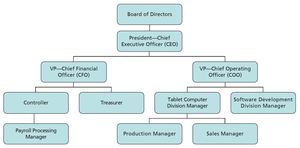
Managers are responsible for various functions within an organization, often structured by departments or divisions. The organizational chart clarifies reporting relationships and responsibilities.
Board of Directors: Sets strategic goals.
Chief Executive Officer (CEO): Implements plans and oversees operations.
Line Positions: Directly involved in producing goods/services.
Staff Positions: Support line positions (e.g., HR, accounting).
Managerial Accounting Functions
Managerial accounting supports three main functions: planning, directing, and controlling.
Planning: Setting goals and strategies (strategic and operational).
Directing: Managing day-to-day operations.
Controlling: Monitoring performance and ensuring goals are met.
Ethical Standards of Managers
Managerial accountants must adhere to ethical standards set by the Institute of Management Accountants (IMA), including competence, confidentiality, integrity, and credibility.
Competence: Maintain professional expertise and provide accurate information.
Confidentiality: Protect sensitive information.
Integrity: Avoid conflicts of interest and unethical conduct.
Credibility: Communicate information fairly and objectively.
Example: If faced with an ethical dilemma, such as pressure to manipulate financial results, accountants should follow organizational policies and escalate concerns if unresolved.
Classifying Costs in Managerial Accounting
Types of Companies and Inventories
Companies are classified as service, merchandising, or manufacturing, each with different inventory types.
Service Companies: Sell time, skill, and knowledge; no inventory.
Merchandising Companies: Resell products; inventory is merchandise purchased.
Manufacturing Companies: Convert raw materials into finished products; inventories include Raw Materials, Work-in-Process, and Finished Goods.
Direct and Indirect Costs
Costs are classified based on their traceability to a cost object.
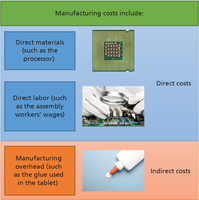
Direct Costs: Easily traced to a cost object (e.g., direct materials, direct labor).
Indirect Costs: Not easily traced (e.g., manufacturing overhead).
Manufacturing Costs
Manufacturing costs are grouped into three categories:
Direct Materials (DM): Raw materials used in production.
Direct Labor (DL): Wages of employees working directly on products.
Manufacturing Overhead (MOH): Indirect costs (e.g., factory rent, utilities, indirect materials/labor).
Prime and Conversion Costs
Prime and conversion costs are important classifications for manufacturing analysis.
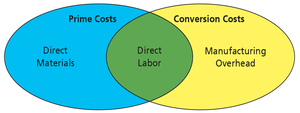
Prime Costs: Direct materials + direct labor.
Conversion Costs: Direct labor + manufacturing overhead.
Product and Period Costs
Costs are also classified as product or period costs, affecting financial reporting.
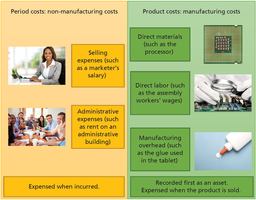
Product Costs: Costs of purchasing or making a product (DM, DL, MOH); recorded as inventory until sold.
Period Costs: Non-manufacturing costs (selling, administrative, taxes, interest); expensed when incurred.
Preparing Financial Statements for a Manufacturer
Balance Sheet
Manufacturing companies use three inventory accounts on the balance sheet: Raw Materials, Work-in-Process, and Finished Goods. Merchandising companies use Merchandise Inventory, while service companies have no inventory.
Income Statement
Manufacturing and merchandising companies report Cost of Goods Sold (COGS) as a major expense. The calculation of COGS differs for manufacturers due to production processes.
Schedule of Cost of Goods Manufactured
The schedule of cost of goods manufactured summarizes the manufacturing costs for products completed during the period. It involves three steps:
Calculate direct materials used.
Calculate total manufacturing costs incurred.
Calculate cost of goods manufactured.
Formula for Cost of Goods Manufactured:
Formula for Cost of Goods Sold:
Business Trends Affecting Managerial Accounting
Key Trends
Modern managerial accounting is influenced by several business trends:
Service Economy: Shift from manufacturing to service-based businesses.
Global Competition: Increased need for cost control and efficiency.
Time-Based Competition: Use of ERP systems and e-commerce for faster operations.
Just-in-Time (JIT) Management: Inventory management to reduce waste.
Advances in Technology: Automation and data analytics.
Total Quality Management (TQM) and Value Chain
TQM is a philosophy of continuous improvement, emphasizing cooperation and value addition at every step of production.
Value Chain: Each step adds value to the final product.
The Triple Bottom Line
Companies are increasingly evaluated on their economic, social, and environmental impact—profits, people, and planet.
Profits: Financial performance.
People: Labor practices and community service.
Planet: Sustainable environmental practices.
Managerial Accounting in Service and Merchandising Companies
Application in Service and Merchandising
Managers use cost information to make pricing decisions and evaluate performance in both service and merchandising companies.
Service Companies: Cost per service is used for pricing and profitability analysis.
Merchandising Companies: Cost per item guides pricing and inventory management.
Example: Smart Touch Learning incurred costs of $3,900 for 1,950 e-learning services, and sold 260 tablets in December 2025.
Additional info: These notes provide a comprehensive overview of Chapter 1, suitable for exam preparation and foundational understanding of managerial accounting concepts.
