 Back
BackJob Order Costing: Structured Study Notes for Managerial Accounting
Study Guide - Smart Notes
 Tailored notes based on your materials, expanded with key definitions, examples, and context.
Job Order Costing
Introduction to Job Order Costing
Job order costing is a fundamental topic in managerial accounting, used to track costs for unique products or services. It enables managers to determine product costs, set sales prices, and make production decisions.
Job Order Costing System: Accumulates costs by job, suitable for unique or specialized products/services.
Process Costing System: Accumulates costs by process, used for identical units produced in mass.
Applications: Used to compute cost of goods sold (COGS) and inventory values for financial statements.
Comparison: Job Order Costing vs. Process Costing
Job Order Costing: Costs are traced to individual jobs; each job may be a single unit or batch.
Process Costing: Costs are traced to processes; used for continuous production of identical items.
Example: Custom furniture (job order) vs. bottled water production (process costing).
Recording Materials and Labor Costs in Job Order Costing
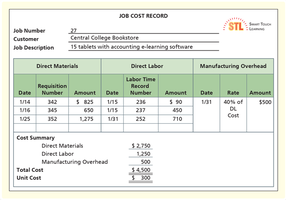
Job Cost Record
A job cost record documents all product costs for each job, including direct materials, direct labor, and manufacturing overhead.
Direct Materials: Materials that can be directly traced to a job.
Direct Labor: Labor costs directly associated with a job.
Manufacturing Overhead: Indirect costs allocated to jobs.
Flow of Product Costs
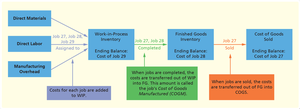
Product costs flow from raw materials to work-in-process, then to finished goods, and finally to cost of goods sold.
Costs for each job are added to Work-in-Process (WIP).
When jobs are completed, costs are transferred to Finished Goods Inventory.
When jobs are sold, costs are transferred to Cost of Goods Sold (COGS).
Purchasing Materials
Raw materials are purchased and stored for later use.
Materials purchased and materials used in production are usually different amounts.
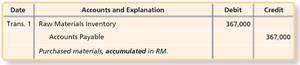
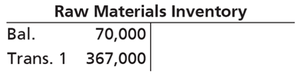
Example: Smart Touch Learning purchases $367,000 of raw materials on account.
Raw Materials Subsidiary Ledger
The subsidiary ledger tracks the details of raw materials received, issued, and remaining balances. 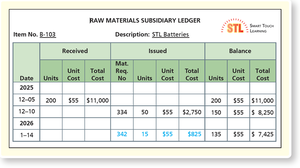
Materials Requisition
A materials requisition is a request to transfer materials to the production floor for a specific job. 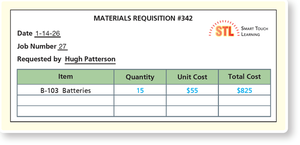
Recording Direct Materials on Job Cost Record
When materials are received on the production floor, direct materials are recorded on the job cost record. 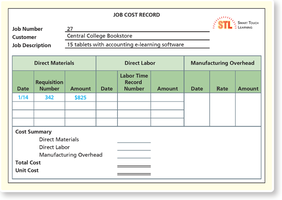
Using Materials: Direct and Indirect
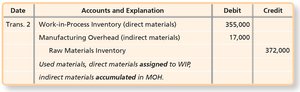
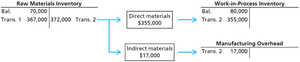
Direct materials are assigned to WIP inventory.
Indirect materials are transferred to Manufacturing Overhead.
Example: $355,000 direct materials and $17,000 indirect materials used.
Labor Costs in Job Order Costing
Tracking Labor Costs
Electronic or manual labor/time records are used to track labor costs.
Direct labor is assigned to jobs; indirect labor is part of manufacturing overhead.
Example: $169,000 direct labor and $28,000 indirect labor incurred.
Recording Actual and Allocated Overhead Costs
Actual Overhead Costs
Overhead includes indirect materials, indirect labor, depreciation, utilities, insurance, and property taxes.
Actual overhead costs are accumulated throughout the period.
Predetermined Overhead Allocation Rate
Calculated before the period based on estimated overhead costs and allocation base (e.g., direct labor hours, direct labor cost, machine hours).
Formula:
Used to allocate overhead to jobs during the period.
Allocating Overhead
Overhead is allocated to jobs as they are completed using the predetermined rate.
Example: If the rate is 40% of direct labor cost, and direct labor for Job 27 is $1,250, then overhead allocated is $500.
Completion and Sale of Finished Goods
Transferring Costs to Finished Goods Inventory
When jobs are completed, costs are transferred from WIP to Finished Goods Inventory.
Example: $644,600 Cost of Goods Manufactured for completed jobs.
Transferring Costs to Cost of Goods Sold
When jobs are sold, costs are transferred from Finished Goods Inventory to COGS.
Example: Sales price $1,200,000; cost $584,600.
Adjusting for Overallocated and Underallocated Overhead
Manufacturing Overhead Adjustment
Underallocated overhead: Actual overhead > allocated overhead.
Overallocated overhead: Actual overhead < allocated overhead.
Adjustment is made to bring the Manufacturing Overhead account to zero at period end.
Calculating Cost of Goods Manufactured and Cost of Goods Sold
Summary of Journal Entries
Journal entries record the flow of costs through the accounting system.
Includes entries for materials purchased, materials used, labor incurred, overhead allocated, jobs completed, and jobs sold.
Job Order Costing for Service Companies
Service Company Application
Service companies use job order costing to trace direct labor and allocate overhead to jobs, even though they do not have inventory or manufacturing costs.
Direct labor is traced to jobs.
Overhead is allocated using a predetermined rate based on direct labor hours.
Costing information is used for pricing decisions.
Example: If direct labor is $50/hour and indirect costs are $30/hour, total hourly rate is $80. Desired profit margin can be added to determine price.
Data Analytics in Accounting
Role of Data Analytics
Job order costing systems accumulate large quantities of data.
Managers use this data for decision making, cost control, and pricing strategies.
Key Terms and Formulas
Direct Materials: Materials directly traceable to a job.
Direct Labor: Labor directly traceable to a job.
Manufacturing Overhead: Indirect costs allocated to jobs.
Cost of Goods Manufactured (COGM): Total cost of jobs completed during the period.
Cost of Goods Sold (COGS): Total cost of jobs sold during the period.
Predetermined Overhead Rate:
Summary Table: Job Order Costing Flow
Stage | Account | Cost Component |
|---|---|---|
Purchase | Raw Materials Inventory | Direct & Indirect Materials |
Production | Work-in-Process Inventory | Direct Materials, Direct Labor, Allocated Overhead |
Completion | Finished Goods Inventory | Cost of Goods Manufactured |
Sale | Cost of Goods Sold | Cost of Goods Sold |
Additional info: Academic context and examples were added to clarify concepts and ensure completeness for exam preparation.
