 Back
BackProcess Costing: Concepts, Calculations, and Production Cost Reports
Study Guide - Smart Notes
 Tailored notes based on your materials, expanded with key definitions, examples, and context.
Process Costing
Introduction to Process Costing
Process costing is a method used by companies that manufacture identical units through a series of processes. Unlike job order costing, which allocates costs by job for unique products, process costing allocates costs by process for homogeneous products.
Job Order Costing: Used for unique products or specialized services; costs are tracked by job.
Process Costing: Used for identical units; costs are tracked by process or department.
Purpose: Helps control costs, set sales prices, and calculate account balances for inventory and cost of goods sold.
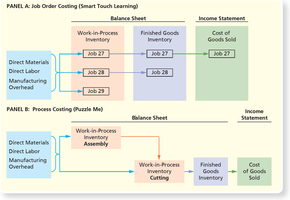
Comparison of Job Order Costing and Process Costing
The main difference between job order and process costing lies in how costs are accumulated and transferred through inventory accounts.
Job Order Costing: Costs are assigned to specific jobs and transferred to finished goods upon completion.
Process Costing: Costs are accumulated by department and transferred sequentially through processes.
Cost Flows in Process Costing
Flow of Costs Through a Process Costing System
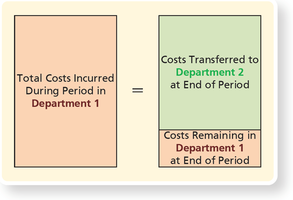
Costs incurred in each department are split between completed units transferred out and units remaining in work-in-process inventory.
Direct Materials: Added at specific points in the process.
Direct Labor: Workers operating machines in each department.
Manufacturing Overhead: Maintenance, depreciation, and indirect costs.
Equivalent Units of Production
Definition and Calculation
Equivalent units of production (EUP) measure the amount of materials added or work done on partially completed units, expressed in terms of fully completed units.
Direct Materials: Often added at the beginning of the process.
Conversion Costs: Sum of direct labor and manufacturing overhead, added throughout the process.
Calculation: EUP for completed units + EUP for units in ending WIP.
Example Calculation
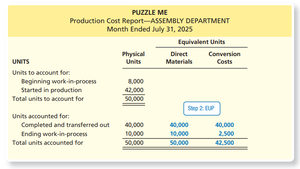
If 40,000 units are completed and transferred out, and 10,000 units are 100% complete for materials and 25% complete for conversion costs:
EUP for direct materials = 40,000 (completed) + 10,000 (ending WIP) = 50,000
EUP for conversion costs = 40,000 (completed) + 2,500 (ending WIP: 10,000 x 25%) = 42,500
Production Cost Report: Weighted-Average Method
Steps to Prepare a Production Cost Report
A production cost report summarizes the physical and cost flows in a department. The weighted-average method combines beginning inventory and current period costs.
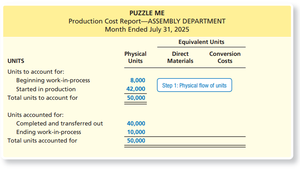
Summarize the flow of physical units.
Compute output in terms of equivalent units of production.
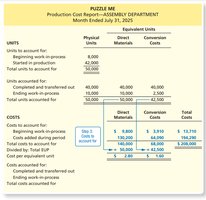
Compute the cost per equivalent unit of production.
Assign costs to units completed and units in process.
Key Terms in Production Cost Reports
To account for: Beginning inventory + units started or added during the period.
Accounted for: Units completed and transferred out + units still in process.
Production Cost Report: Example Table
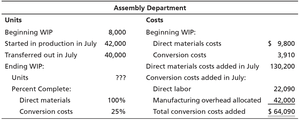
Assembly Department Data for July
Units | Costs |
|---|---|
Beginning WIP: 8,000 | Direct materials: $9,800 |
Started in production: 42,000 | Conversion costs: $3,910 |
Transferred out: 40,000 | Direct materials added: $130,200 |
Ending WIP: 10,000 | Direct labor: $22,090 |
Percent Complete: DM 100%, CC 25% | Manufacturing overhead: $42,000 |
Total conversion costs: $64,090 |
Assigning Costs: Weighted-Average Method
Cost Assignment Table
Units | Direct Materials | Conversion Costs | Total |
|---|---|---|---|
Completed & transferred out: 40,000 | 40,000 | 40,000 | 80,000 |
Ending WIP: 10,000 | 10,000 | 2,500 | 12,500 |
Total units accounted for: 50,000 | 50,000 | 42,500 | 92,500 |
Production Cost Report for Subsequent Departments
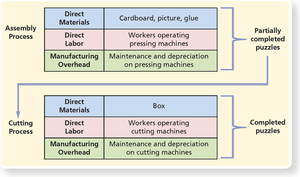
Cutting Department
The Cutting Department receives puzzle boards from the Assembly Department and adds its own direct materials and conversion costs.
Transferred-in costs: Costs incurred in previous departments, brought into the current department.
Direct materials: Added at the end of the process.
Conversion costs: Added evenly throughout the process.
Journal Entries in Process Costing
Journal Entry Flow
Costs flow through the process costing system in four steps: accumulate, assign, allocate, and adjust.
Raw materials purchased
Raw materials used in production
Labor costs incurred
Manufacturing overhead incurred and allocated
Transfers between departments
Transfers to finished goods inventory
Sales and cost of goods sold
Adjustments for over/underallocated overhead
Using Production Cost Reports for Decision Making
Applications
Production cost reports are used to:
Control costs
Evaluate performance
Price products
Identify profitable products
Prepare financial statements
FIFO Method in Process Costing
First-In, First-Out Method
The FIFO method accounts for beginning inventory separately and assigns costs based on the order of completion.
Weighted-Average Method: Combines beginning inventory and current period costs.
FIFO Method: Separates beginning inventory and assigns costs to units started and completed during the period.
Key Formulas
Equivalent Units of Production
Cost per Equivalent Unit (Weighted-Average)
Cost Assignment
Summary Table: Process Costing Steps
Step | Description |
|---|---|
1 | Summarize physical units |
2 | Compute equivalent units of production |
3 | Compute cost per equivalent unit |
4 | Assign costs to completed units and ending WIP |
Additional info: Academic context and formulas have been added to ensure completeness and clarity for exam preparation.
