 Back
Musculoskeletal System: Medical Terminology Study Guide
Study Guide - Smart Notes
 Tailored notes based on your materials, expanded with key definitions, examples, and context.
Musculoskeletal System Overview
Introduction
The musculoskeletal system is composed of bones, joints, and muscles, providing structural support, movement, protection of internal organs, blood cell production, and mineral storage. Understanding medical terminology related to this system is essential for accurate communication in healthcare.
Skeletal System
Major Functions and Structure
Support: Framework for the body.
Protection: Shields vital organs (e.g., skull protects brain).
Movement: Muscles attach to bones for movement.
Blood Cell Production: Red bone marrow produces blood cells.
Mineral Storage: Stores calcium and phosphorus.
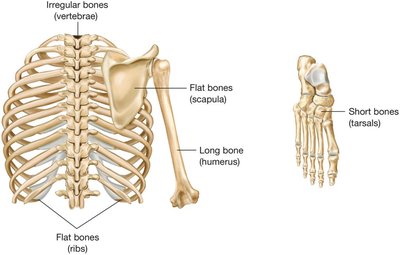
Classification of Bones
Bones are classified by shape:
Long bones: e.g., humerus, femur
Short bones: e.g., tarsals
Flat bones: e.g., ribs, scapula
Irregular bones: e.g., vertebrae
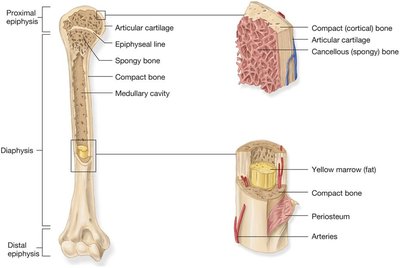
Structure of a Long Bone
Long bones have distinct anatomical features:
Diaphysis: Shaft of the bone
Epiphysis: Ends of the bone (proximal and distal)
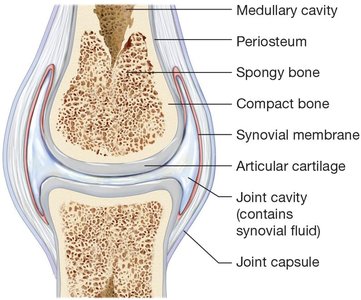
Medullary cavity: Contains marrow (red in youth, yellow in adults)
Articular cartilage: Covers epiphysis, reduces friction
Periosteum: Membrane covering bone, contains blood vessels and nerves
Compact (cortical) bone: Dense outer layer
Cancellous (spongy) bone: Inner layer with spaces for marrow
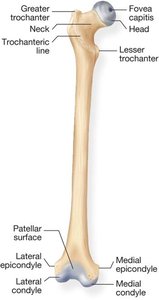
Bony Projections and Depressions
Bones have various projections and depressions for muscle attachment and articulation:
Head: Ball-shaped end (e.g., femur)
Condyle: Rounded end (e.g., femur)
Epicondyle: Projection above condyle
Trochanter: Large rough process (muscle attachment)
Tubercle/Tuberosity: Small/large rough process (muscle/tendon attachment)
Sinus: Hollow cavity
Foramen: Opening for nerves/vessels
Fossa: Shallow depression
Fissure: Slit-like opening
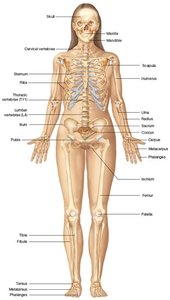
Axial and Appendicular Skeleton
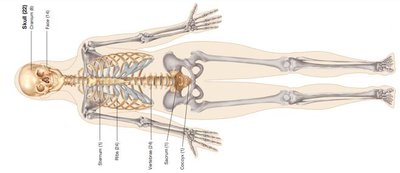
The skeleton is divided into two main parts:
Axial skeleton: Skull, vertebral column, rib cage, sternum
Appendicular skeleton: Pectoral girdle, upper limbs, pelvic girdle, lower limbs
Skull Anatomy
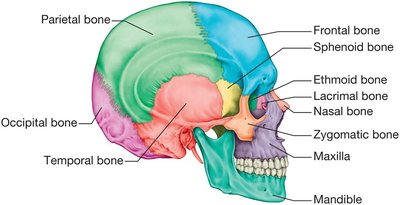
The skull consists of cranial and facial bones:
Cranial bones: Frontal, parietal, temporal, ethmoid, sphenoid, occipital
Facial bones: Mandible, maxilla, zygomatic, vomer, palatine, nasal, lacrimal
Vertebral Column
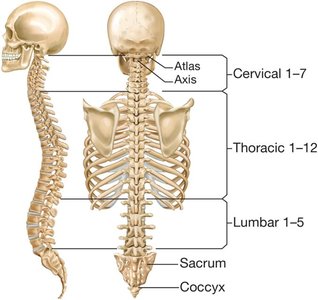
The vertebral column is divided into five regions:
Cervical (7): Neck
Thoracic (12): Chest
Lumbar (5): Lower back
Sacrum: Fused vertebrae
Coccyx: Tailbone
Rib Cage
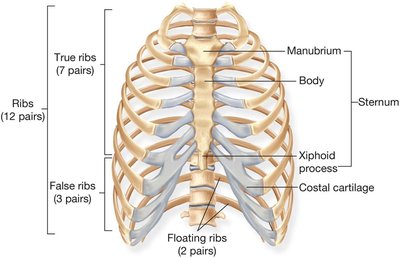
The rib cage consists of:
True ribs (7 pairs): Attach directly to sternum
False ribs (3 pairs): Indirect attachment
Floating ribs (2 pairs): No attachment to sternum
Pectoral and Pelvic Girdles
The pectoral girdle connects the upper limbs; the pelvic girdle connects the lower limbs:
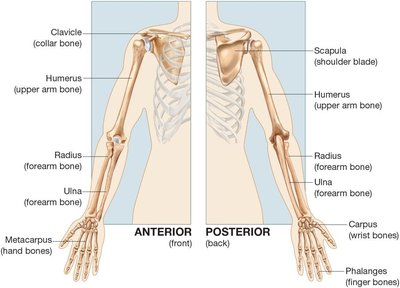
Pectoral girdle: Clavicle, scapula
Upper extremity: Humerus, radius, ulna, carpals, metacarpals, phalanges
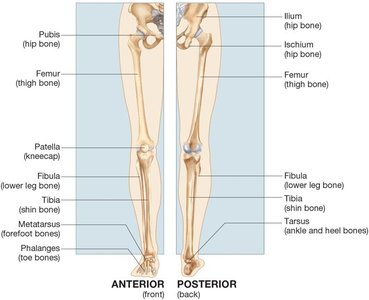
Pelvic girdle: Ilium, ischium, pubis
Lower extremity: Femur, patella, tibia, fibula, tarsals, metatarsals, phalanges
Joints
Types of Joints
Joints (articulations) are classified by movement:
Synovial joints: Freely movable, enclosed by joint capsule, lined with synovial membrane, contains synovial fluid, articular cartilage, ligaments, sometimes bursae and menisci
Cartilaginous joints: Slightly movable, bones joined by cartilage (e.g., pubic symphysis)
Fibrous joints: Immovable, bones joined by fibrous tissue (e.g., skull sutures)
Medical Terminology: Skeletal System
Combining Forms, Suffixes, and Prefixes
Combining forms: oste/o (bone), chondr/o (cartilage), arthr/o (joint), myel/o (bone marrow/spinal cord), etc.
Suffixes: -itis (inflammation), -algia (pain), -clasia (break), -desis (fuse), -ectomy (removal), -plasty (repair), -porosis (porous), -scope (instrument for viewing), -scopy (process of viewing)
Prefixes: a- (without), bi- (two), inter- (between), intra- (within), sub- (below), etc.
Adjective Forms
Carpal: Pertaining to the wrist
Cervical: Pertaining to the neck
Femoral: Pertaining to the femur
Vertebral: Pertaining to the vertebra
Patellar: Pertaining to the kneecap
Pathology: Skeletal System
Fractures
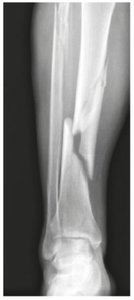
Types of bone fractures include:
Closed (simple): No open wound
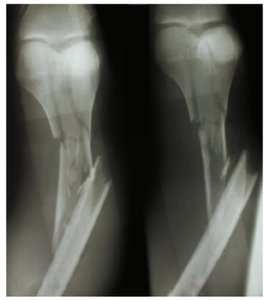
Comminuted: Bone shattered
Compound (open): Bone protrudes through skin
Compression: Loss of height in vertebral body
Greenstick: Incomplete break, common in children
Oblique: Fracture at an angle
Spiral: Fracture line spirals around bone
Transverse: Fracture straight across bone
Bone Pathologies
Osteoporosis: Decreased bone mass, porous bones
Osteomalacia: Softening of bones due to calcium deficiency
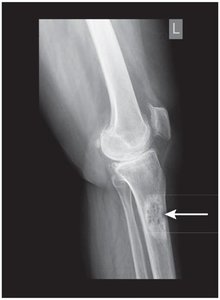
Osteomyelitis: Inflammation of bone and marrow
Osteogenic sarcoma: Bone cancer
Paget disease: Metabolic bone disease
Spinal Pathologies
Kyphosis: Excessive posterior thoracic curvature (hunchback)
Lordosis: Excessive anterior lumbar curvature (swayback)
Scoliosis: Lateral curvature of spine
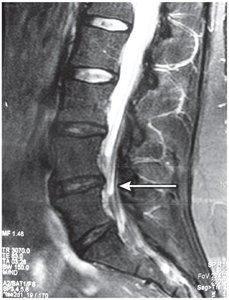
Herniated nucleus pulposus: Ruptured intervertebral disk
Muscular System
Overview and Functions
The muscular system works with the skeletal system to produce movement. Muscles contract to move bones, maintain posture, and generate heat.
Types of Muscle Tissue
Skeletal muscle: Voluntary, striated, attached to bones
Smooth muscle: Involuntary, unstriated, found in internal organs
Cardiac muscle: Involuntary, striated, found in heart
Muscle Actions and Terminology
Origin: Less movable bone
Insertion: More movable bone
Action: Type of movement produced
Antagonistic pairs: Muscles producing opposite actions
Movement Terminology
Abduction: Movement away from midline
Adduction: Movement toward midline
Flexion: Bending
Extension: Straightening
Dorsiflexion: Bending foot upward
Plantar flexion: Pointing toes downward
Eversion/Inversion: Turning foot outward/inward
Pronation/Supination: Turning palm downward/upward
Circumduction: Circular movement
Opposition: Thumb touching fingers
Rotation: Revolving around axis
Medical Terminology: Muscular System
Combining Forms, Suffixes, and Prefixes
Combining forms: my/o (muscle), ten/o (tendon), kinesi/o (movement), fasci/o (fascia)
Suffixes: -algia (pain), -asthenia (weakness), -kinesia (movement), -trophy (development), -itis (inflammation), -pathy (disease)
Prefixes: a- (without), brady- (slow), dys- (abnormal), hyper- (excessive), hypo- (insufficient), poly- (many)
Pathology: Muscular System
Fibromyalgia: Widespread muscle pain
Muscular dystrophy: Inherited progressive muscle atrophy
Myopathy: General muscle disease
Necrotizing fasciitis: Infection causing tissue death
Carpal tunnel syndrome: Compression of median nerve in wrist
Rotator cuff injury: Strain/tear of shoulder tendons
Tendinitis: Inflammation of tendon
Diagnostic Procedures
Skeletal System
Arthrography: X-ray of joint with contrast
Bone scan: Nuclear medicine imaging
Dual-energy absorptiometry (DXA): Measures bone density
Myelography: Imaging of spinal cord
Radiography: X-ray imaging
Arthroscopy: Endoscopic examination of joint
Muscular System
Creatine kinase (CK): Blood test for muscle enzyme
Electromyography (EMG): Measures muscle contraction
Muscle biopsy: Removal of muscle tissue for examination
Therapeutic Procedures
Skeletal System
Arthrocentesis: Removal of fluid from joint
Orthotic: Brace or splint
Prosthesis: Artificial device for missing body part
Amputation: Removal of limb
Arthrodesis: Joint fusion
Arthroscopic surgery: Surgery using arthroscope
Bone graft: Transplant of bone tissue
Craniotomy: Cutting into skull
Laminectomy: Removal of vertebral arch
Meniscectomy: Removal of meniscus
Osteotomy: Cutting into bone
Spinal fusion: Immobilization of vertebrae
Total hip/knee arthroplasty: Prosthetic joint implantation
Muscular System
Carpal tunnel release: Cutting ligament to relieve pressure
Fasciotomy: Cutting into fascia
Myoplasty: Surgical repair of muscle
Myorrhaphy: Suturing muscle
Tendoplasty: Surgical repair of tendon
Tendotomy: Cutting into tendon
Tenodesis: Fusing tendon
Tenorrhaphy: Suturing tendon
Pharmacology
Skeletal System
Bone reabsorption inhibitors: Treat osteoporosis (e.g., alendronate)
Calcium/vitamin D supplements: Maintain bone density
Corticosteroids: Anti-inflammatory (e.g., prednisone)
NSAIDs: Pain relief and anti-inflammatory (e.g., ibuprofen)
Muscular System
Skeletal muscle relaxants: Reduce muscle spasm (e.g., Flexeril)
Abbreviations
CK: Creatine kinase
CPK: Creatine phosphokinase
CTS: Carpal tunnel syndrome
DTR: Deep tendon reflexes
EMG: Electromyogram
IM: Intramuscular
MD: Muscular dystrophy
NF: Necrotizing fasciitis
Additional info: This guide expands on brief lecture notes with academic context, definitions, and examples to ensure completeness and clarity for exam preparation.
