 Back
BackAcellular Infectious Agents: Viruses, Viroids & Prions quiz #1
- Acellular Infectious Agents: Viruses, Viroids & Prions quiz #2Acellular Infectious Agents: Viruses, Viroids & Prions12 Terms
- Acellular Infectious Agents: Viruses, Viroids & Prions quiz #3Acellular Infectious Agents: Viruses, Viroids & Prions14 Terms
- Acellular Infectious Agents: Viruses, Viroids & Prions quiz #4Acellular Infectious Agents: Viruses, Viroids & Prions5 Terms

 03:22
03:22
Terms in this set (27)
What are prions?
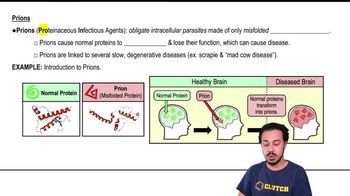
Prions are infectious agents made solely of misfolded proteins and can cause normal proteins to misfold, leading to disease.
What is a characteristic found only in some viruses?
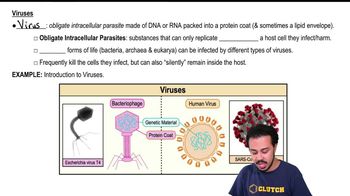
Some viruses possess a lipid envelope surrounding their protein coat.
What is a characteristic of a virus?
Viruses are obligate intracellular parasites composed of either DNA or RNA within a protein coat.
What is the benefit for a bacteriophage to be a temperate (or lysogenic) virus?
Temperate bacteriophages can integrate their genome into the host cell's DNA, allowing them to persist without immediately killing the host.
Most enveloped viruses belong to which category on basis of host?
Most enveloped viruses are animal viruses.
Which characteristic do viruses possess in common with living cells?
Viruses contain genetic material (DNA or RNA), similar to living cells.
Why are viruses often considered to be nonliving?
Viruses are considered nonliving because they are not made of cells and cannot reproduce independently.
What are viruses called which are capable of converting their RNA genomes into DNA?
Viruses capable of converting their RNA genomes into DNA are called retroviruses.
What do all viruses have in common?
All viruses have genetic material (DNA or RNA) enclosed in a protein coat.
What virus is a common cause of viral gastroenteritis?
Norovirus is a common cause of viral gastroenteritis.
Why can't a virus reproduce on its own?
A virus cannot reproduce on its own because it lacks cellular machinery and must use a host cell to replicate.
Why must viruses use living cells to reproduce?
Viruses lack the cellular structures needed for replication and must hijack a host cell's machinery.
Why are viruses not considered to be living organisms?
Viruses are not considered living because they are acellular and cannot carry out metabolism or reproduce independently.
What is a basic characteristic of a virus?
A basic characteristic of a virus is that it is an obligate intracellular parasite.
Which of these describes a difference between viruses and cells?
Viruses are acellular and cannot carry out metabolism, while cells are living and metabolically active.
How are viruses different from eukaryotic cells?
Viruses lack cellular structures and cannot reproduce or metabolize independently, unlike eukaryotic cells.
What is one major difference between viruses and bacteria?
Viruses are not made of cells, while bacteria are cellular organisms.
From which phrase is the term 'prions' derived?
The term 'prions' is derived from 'proteinaceous infectious agents.'
What is the source of a viral envelope?
A viral envelope is typically derived from the host cell membrane.
Which is closest in physical proximity to the nucleic acid of a virus?
The protein capsid is closest to the nucleic acid of a virus.
What is the monomeric unit of a viral capsid?
The monomeric unit of a viral capsid is a capsomere.
What do viruses typically need to infect and replicate?
Viruses need a host cell to infect and replicate.
What characteristics can be utilized to classify and categorize viruses?
Viruses can be classified by their genetic material (DNA or RNA), shape, and presence of an envelope.
Which group of microorganisms is composed only of hereditary material wrapped in a protein covering?
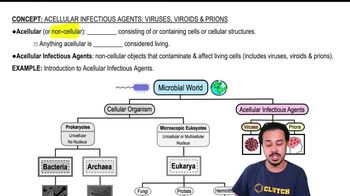
Viruses are composed only of hereditary material (DNA or RNA) wrapped in a protein coat.
What would a virally infected skin epithelial cell have on its cell surface?
A virally infected cell may display viral antigens on its surface.
What is a viroid?
A viroid is a small, circular single-stranded RNA molecule that infects plants.
Which type of capsids are composed of multiple protein types and nonsymmetrical shapes?
Complex capsids are composed of multiple protein types and have nonsymmetrical shapes.