Acellular Infectious Agents: Viruses, Viroids & Prions quiz #2 Flashcards
Acellular Infectious Agents: Viruses, Viroids & Prions quiz #2
You can tap to flip the card.
Control buttons has been changed to "navigation" mode.
1/38
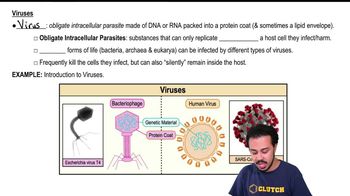
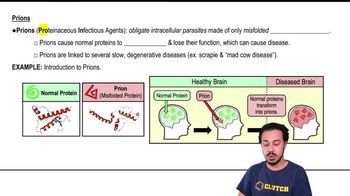
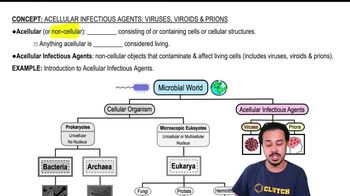
Which of the following can be found in a bacteriophage?A bacteriophage contains genetic material and a protein capsid.Which of the following samples most likely contains a double-stranded RNA virus?A sample with double-stranded RNA as its genetic material likely contains a double-stranded RNA virus.Are viruses alive?No, viruses are not alive because they are not made of cells.Are viruses living?No, viruses are considered nonliving because they lack cellular structure.Which statement best describes how a virus replicates?A virus replicates by infecting a host cell and using the host's machinery to produce new viral particles.What are the three main criteria used to classify viruses?Viruses are classified by their genetic material, shape, and presence or absence of an envelope.Why do viruses not fit easily into the broadest taxonomic category?Viruses do not fit easily into taxonomy because they are acellular and not considered living organisms.Which of the following best describes a prion?A prion is an infectious agent composed solely of misfolded protein.Which of these sentences is true about viruses?Viruses are obligate intracellular parasites that require a host cell to replicate.Which labeled viral structure in the diagram above attaches the virus to the host cell?The viral attachment proteins or spikes attach the virus to the host cell.Which labeled virus structure in the diagram above attaches the virus to the host cell?The viral attachment proteins or spikes are responsible for attaching the virus to the host cell.A virus that infects an executable program file is known as?This refers to a computer virus; in biology, viruses infect living cells.Which of the following viral types enter animal cells via fusion with the animal cell membrane?Enveloped viruses enter animal cells via fusion with the cell membrane.Which best explains why viruses are not classified by Linnaean taxonomy?Viruses are not classified by Linnaean taxonomy because they are acellular and not considered living.Which of the following do not get infected by viruses?Viruses do not infect nonliving objects.What is not a typical sign of virus activity on a system?In biology, a lack of symptoms is not a typical sign of viral activity.Which of the following is not a way in which viruses differ from all other living things?Viruses do not carry out metabolism, unlike living things.Which of the following toxins is not produced by a bacterium as a result of lysogenic conversion?Prion proteins are not produced by bacteria as a result of lysogenic conversion.A tiny, nonliving particle that invades and then reproduces inside a living cell.A virus is a tiny, nonliving particle that invades and reproduces inside a living cell.Which component of a virus is lacking in a cell?Cells lack a viral capsid.The medical term that means pertaining to a virus isThe medical term is 'viral.'The term meaning pertaining to a virus is'Viral' means pertaining to a virus.Which is a characteristic of a virus, but not a bacterium?Viruses are acellular and require a host for replication.Which of the following illustrates a complex virus?A bacteriophage is an example of a complex virus.Which of these is the viral genome?The viral genome is the DNA or RNA inside the virus.The pointer is indicating the virus's _____.The pointer is indicating the virus's capsid or genetic material, depending on the diagram.The host range of a virus is determined byThe host range is determined by the virus's ability to attach to specific host cell receptors.The mechanism whereby an enveloped virus leaves a host cell is calledBudding is the mechanism by which an enveloped virus leaves a host cell.The virus-induced, specific damage to the host cell that can be seen in a light microscope is calledCytopathic effect is the virus-induced damage visible under a microscope.Infection of bacteria by phages always ends with the lysis of the host cell.False. Some phages can integrate into the host genome without immediate lysis.Pertaining to a virus medical termThe medical term is 'viral.'Double-stranded viral DNA is incorporated into a host cell as a _____.Double-stranded viral DNA is incorporated as a provirus.The nucleocapsid consists ofThe nucleocapsid consists of the viral genome and the protein capsid.Which component of a virus is injected into a cell?The viral genetic material (DNA or RNA) is injected into the host cell.Viral growth in bird embryos can cause discrete, opaque spots in the embryonic membranes calledThese spots are called pocks.A tiny, nonliving particle that invades and then reproduces inside a living cellA virus is a tiny, nonliving particle that invades and reproduces inside a living cell.Any virus that specifically infects bacteria is called a(n) .A virus that infects bacteria is called a bacteriophage.Viruses are ___ inside protein shells.Viruses are genetic material (DNA or RNA) inside protein shells.