Skip to main content
Microbiology
My Course
Learn
Exam Prep
AI Tutor
Study Guides
Textbook Solutions
Flashcards
Explore
Try the app
My Course
Learn
Exam Prep
AI Tutor
Study Guides
Textbook Solutions
Flashcards
Explore
Try the app
Back
Acne definitions
You can tap to flip the card.
Cutibacterium acnes
You can tap to flip the card.
👆
Cutibacterium acnes
Gram-positive, rod-shaped bacterium responsible for most cases, thriving on excess sebum in hair follicles.
Track progress
Control buttons has been changed to "navigation" mode.
1/15
Related flashcards
Related practice
Recommended videos
Acne quiz
Acne
15 Terms
Acne
29. Microbial Infections - Skin and Eyes
2 problems
Topic
Measles
29. Microbial Infections - Skin and Eyes
1 problem
Topic
29. Microbial Infections - Skin and Eyes - Part 1 of 2
4 topics
8 problems
Chapter
29. Microbial Infections - Skin and Eyes - Part 2 of 2
1 topic
2 problems
Chapter
05:43
Acne
240
views
9
rank
Terms in this set (15)
Hide definitions
Cutibacterium acnes
Gram-positive, rod-shaped bacterium responsible for most cases, thriving on excess sebum in hair follicles.
Sebaceous glands
Skin structures producing sebum, whose increased activity during puberty promotes bacterial growth and follicle blockage.
Sebum
Oily substance secreted by skin glands, serving as a nutrient source for bacteria and contributing to pore blockage.
Whitehead
Closed comedone formed by clogged hair follicles, appearing light due to lack of air exposure.
Blackhead
Open comedone resulting from clogged follicles, darkened by oxidation rather than dirt.
Comedone
General term for clogged hair follicle, which may be open or closed, leading to visible skin lesions.
Nodular cystic acne
Severe form marked by deep, inflamed lesions with high risk of permanent scarring.
Scar tissue
Fibrous tissue replacing normal skin after deep inflammation, often resulting in lasting marks.
Skin microbiome
Community of microorganisms, including bacteria, normally residing on the skin and influencing health.
Benzoyl peroxide
Topical agent used to kill bacteria and reduce inflammation in mild to moderate cases.
Salicylic acid
Topical treatment that exfoliates skin, helping to unclog pores and manage mild symptoms.
Tetracyclines
Class of antibiotics prescribed for moderate to severe cases to reduce bacterial load and inflammation.
Macrolides
Antibiotic group used in treatment, especially when other agents are ineffective or contraindicated.
Visual inspection
Primary diagnostic method involving direct observation of skin lesions to assess severity.
Hormonal changes
Physiological shifts, especially during puberty, that increase sebum production and predispose to outbreaks.
 BackBack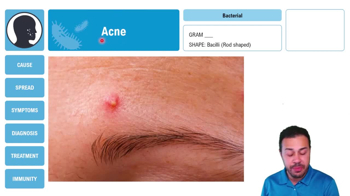
 05:43
05:43