Bacterial & Eukaryotic Cell Membranes quiz #1 Flashcards

Bacterial & Eukaryotic Cell Membranes quiz #1
Control buttons has been changed to "navigation" mode.
1/10
  • Where are phospholipids most likely found in a prokaryotic (bacterial) cell?
    Phospholipids are most likely found in the cell membrane of a prokaryotic (bacterial) cell, forming a phospholipid bilayer that serves as the main structural component of the membrane.
  • Label the following figure with the appropriate attributes for bacterial and archaeal membranes: Indicate the type of linkage (ester or ether) connecting the phospholipid head and tails, and note the presence or absence of cholesterol.
    Bacterial membranes have phospholipids with ester linkages and lack cholesterol. Archaeal membranes have phospholipids with ether linkages and also lack cholesterol.
  • What does it mean for a phospholipid to be amphipathic?
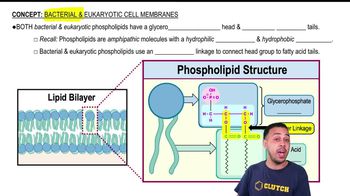
    An amphipathic molecule has both hydrophilic (water-loving) and hydrophobic (water-fearing) regions; in phospholipids, the head is hydrophilic and the tails are hydrophobic.
  • What is the chemical structure of a phospholipid in bacterial and eukaryotic membranes?
    A phospholipid consists of a glycerophosphate head attached to two fatty acid tails via ester linkages.
  • How do lipid rafts move within animal cell membranes?
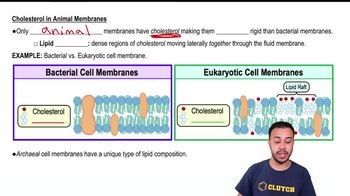
    Lipid rafts, which are dense regions of cholesterol, can move laterally together through the fluid membrane.
  • What role does cholesterol play in animal cell membranes?
    Cholesterol increases the rigidity of animal cell membranes and helps form lipid rafts important for bio-signaling.
  • Are proteins present in bacterial cell membranes, and if so, how are they arranged?
    Yes, proteins are embedded within the phospholipid bilayer of bacterial cell membranes.
  • Why are archaeal cell membranes discussed separately from bacterial and eukaryotic membranes?
    Archaeal cell membranes have a unique lipid composition and use ether linkages, making them distinct from bacterial and eukaryotic membranes.
  • What is the main difference between the linkages in bacterial/eukaryotic and archaeal phospholipids?
    Bacterial and eukaryotic phospholipids use ester linkages, while archaeal phospholipids use ether linkages.
  • What is the function of the glycerophosphate head in a phospholipid?
    The glycerophosphate head is hydrophilic, allowing it to interact with water and form the outer surface of the membrane.