Binary Fission quiz #1 Flashcards

Binary Fission quiz #1
Control buttons has been changed to "navigation" mode.
1/13
  • Which statement is true regarding binary fission?
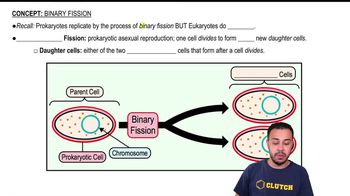
    Binary fission is a method of asexual reproduction in prokaryotes where a single parental cell divides to form two genetically identical daughter cells.
  • How do prokaryotic cells reproduce?
    Prokaryotic cells reproduce by binary fission, a process in which one cell divides into two identical daughter cells.
  • By what process does a prokaryotic cell reproduce?
    A prokaryotic cell reproduces by binary fission.
  • What results when a single bacterium reproduces by binary fission?
    When a single bacterium reproduces by binary fission, it produces two genetically identical daughter cells.
  • Which series lists the correct order of steps of binary fission from first to last?
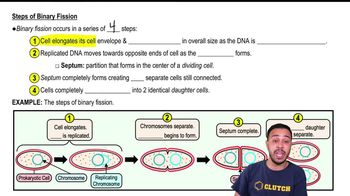
    1) Cell elongation and DNA replication, 2) Movement of replicated DNA to opposite ends and septum formation, 3) Complete formation of the septum, 4) Full separation into two identical daughter cells.
  • Which of the following processes does not occur in dividing bacteria: mitosis, chromosome replication, septum formation, or cell elongation?
    Mitosis does not occur in dividing bacteria; they divide by binary fission.
  • How do bacteria reproduce?
    Bacteria reproduce by binary fission.
  • Which describes the process of a bacterial cell dividing to create two daughter cells?
    Binary fission describes the process where a bacterial cell divides to create two genetically identical daughter cells.
  • During binary fission in a bacterium, what happens to the DNA?
    During binary fission, the DNA is replicated so that each daughter cell receives an identical copy.
  • Bacteria given the right nutrients can divide and form a ________.
    Bacteria given the right nutrients can divide and form a colony of identical cells.
  • Most cultured bacteria tend to multiply by which process?
    Most cultured bacteria tend to multiply by binary fission.
  • Binary fission produces __________.
    Binary fission produces two genetically identical daughter cells.
  • As bacteria absorb food, each cell grows in size and divides, resulting in how many new cells?
    Each bacterial cell divides to produce two new cells.