Skip to main content
Microbiology
My Course
Learn
Exam Prep
AI Tutor
Study Guides
Textbook Solutions
Flashcards
Explore
Try the app
My Course
Learn
Exam Prep
AI Tutor
Study Guides
Textbook Solutions
Flashcards
Explore
Try the app
Back
Carbon definitions
You can tap to flip the card.
Carbon
You can tap to flip the card.
👆
Carbon
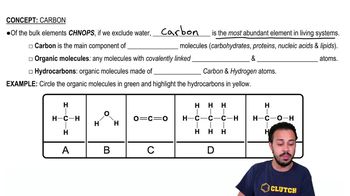
Most abundant element in living systems (excluding water); forms the backbone of organic molecules due to its bonding versatility.
Track progress
Control buttons has been changed to "navigation" mode.
1/14
Related flashcards
Related practice
Recommended videos
Carbon quiz
Carbon
15 Terms
Carbon
5. Molecules of Microbiology
5 problems
Topic
Nicole
Functional Groups
5. Molecules of Microbiology
3 problems
Topic
Brendan
5. Molecules of Microbiology
8 topics
14 problems
Chapter
Nicole
03:35
Carbon is an Excellent Building Block
22954
views
911
rank
04:19
Carbon
30213
views
714
rank
Terms in this set (14)
Hide definitions
Carbon
Most abundant element in living systems (excluding water); forms the backbone of organic molecules due to its bonding versatility.
Organic Molecule
Compound containing covalently linked carbon and hydrogen atoms, forming the basis of life's molecular diversity.
Hydrocarbon
Subset of organic compounds made exclusively of carbon and hydrogen atoms, lacking other elements.
Covalent Bond
Strong chemical connection where atoms share electron pairs, enabling stable molecular structures.
Carbohydrate
Class of organic molecules built from carbon, hydrogen, and oxygen; serves as energy source and structural component.
Protein
Organic macromolecule composed of amino acids; essential for structure, function, and regulation in living organisms.
Nucleic Acid
Macromolecule storing and transmitting genetic information; includes DNA and RNA.
Lipid
Diverse group of hydrophobic organic molecules, important for energy storage and membrane structure.
Carbon Backbone
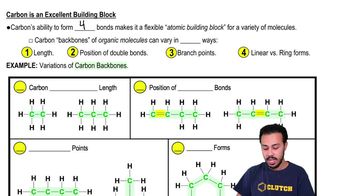
Linear, branched, or ring-shaped chain of carbon atoms forming the structural framework of organic molecules.
Double Bond
Type of covalent linkage where two pairs of electrons are shared between atoms, affecting molecule shape and reactivity.
Branch Point
Location in a carbon chain where a side chain diverges from the main backbone, increasing molecular complexity.
Ring Structure
Cyclic arrangement of carbon atoms in a molecule, contributing to chemical stability and diversity.
Methane
Simplest hydrocarbon, consisting of one carbon atom bonded to four hydrogens; foundational example in organic chemistry.
CHNOPS
Acronym for the six most common elements in living organisms: carbon, hydrogen, nitrogen, oxygen, phosphorus, sulfur.
 BackBack
 03:35
03:35