Cells of the Immune System: Agranulocytes quiz #1 Flashcards

Cells of the Immune System: Agranulocytes quiz #1
Control buttons has been changed to "navigation" mode.
1/10
  • True or false: B cells are leukocytes of the innate immune system.
    False. B cells are lymphocytes that are part of the adaptive immune system, not the innate immune system.
  • Which leukocyte transforms into a macrophage when it moves from the blood into the tissues?
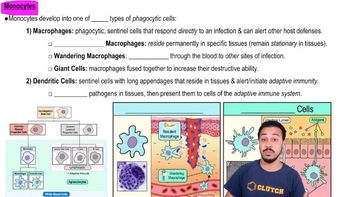
    Monocytes transform into macrophages when they move from the blood into the tissues.
  • What distinguishes agranulocytes from granulocytes under a light microscope?
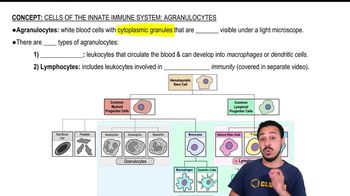
    Agranulocytes lack visible cytoplasmic granules under a light microscope, while granulocytes have granules that are visible.
  • What are the two main types of agranulocytes discussed in the immune system?
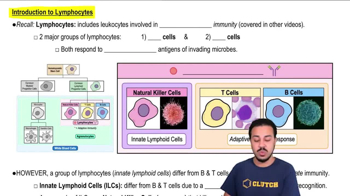
    The two main types of agranulocytes are monocytes and lymphocytes.
  • What is the primary function of resident macrophages in tissues?
    Resident macrophages remain stationary in specific tissues and are ready to respond immediately to infection or tissue damage.
  • How do giant cells form and what is their significance?
    Giant cells form when macrophages fuse together, resulting in increased destructive abilities.
  • What role do dendritic cells play in activating adaptive immunity?
    Dendritic cells ingest pathogens, process them, and present their antigens to B cells and T cells to activate adaptive immune responses.
  • What is a key structural feature of dendritic cells that aids their function?
    Dendritic cells have long appendages that help them sample antigens from their environment.
  • From which progenitor cell do lymphocytes originate?
    Lymphocytes originate from the common lymphoid progenitor cell.
  • How do innate lymphoid cells (ILCs) differ from B and T cells in antigen recognition?
    Innate lymphoid cells, such as natural killer cells, lack antigen specificity, whereas B and T cells are highly specific to antigens.