Back

Central Dogma definitions

Control buttons has been changed to "navigation" mode.
1/14
  • Central Dogma

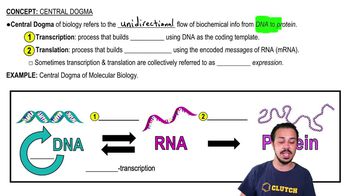
    Describes the one-way flow of biochemical information from DNA to protein, emphasizing the inability to reverse this flow from protein to DNA.
  • Transcription

    The process where RNA is synthesized using DNA as a template, producing messenger RNA as the primary product.
  • Translation

    The process where proteins are synthesized using the encoded messages carried by messenger RNA.
  • Gene Expression

    The combined processes of transcription and translation, resulting in the production of a gene's final product, often a protein.
  • DNA

    A nucleic acid serving as the primary template for storing and transmitting genetic information in cells.
  • RNA

    A nucleic acid synthesized from DNA, acting as an intermediary in the flow of genetic information toward protein synthesis.
  • Messenger RNA

    A specific type of RNA that carries genetic instructions from DNA to the ribosome for protein synthesis.
  • Replication

    The process where DNA is duplicated, using an existing DNA strand as a template to produce identical DNA molecules.
  • Reverse Transcription

    A process where DNA is synthesized from an RNA template, reversing the usual flow of genetic information.
  • Protein

    A macromolecule synthesized during translation, serving as the functional product of gene expression.
  • Unidirectional Flow

    The concept that genetic information moves in one direction, from DNA to RNA to protein, without reversal from protein.
  • Nucleic Acid

    A class of biomolecules, including DNA and RNA, responsible for storing and transmitting genetic information.
  • Template

    A molecular strand used as a guide for synthesizing a complementary strand during processes like transcription or replication.
  • Gene

    A segment of DNA containing the instructions necessary for producing a specific functional product, typically a protein.