Skip to main content
Microbiology
My Course
Learn
Exam Prep
AI Tutor
Study Guides
Textbook Solutions
Flashcards
Explore
Try the app
My Course
Learn
Exam Prep
AI Tutor
Study Guides
Textbook Solutions
Flashcards
Explore
Try the app
Back
Chargaff's Rules definitions
You can tap to flip the card.
Chargaff's Rules
You can tap to flip the card.
👆
Chargaff's Rules
Set of observations stating that DNA base composition varies by species and that adenine equals thymine, while guanine equals cytosine.
Track progress
Control buttons has been changed to "navigation" mode.
1/14
Related flashcards
Related practice
Recommended videos
Chargaff's Rules quiz
Chargaff's Rules
15 Terms
Chargaff's Rules
14. DNA Replication
3 problems
Topic
Nicole
Discovering the Structure of DNA
14. DNA Replication
3 problems
Topic
Nicole
14. DNA Replication
10 topics
14 problems
Chapter
Brendan
04:33
Chargaff's Rules
12473
views
147
rank
Terms in this set (14)
Hide definitions
Chargaff's Rules
Set of observations stating that DNA base composition varies by species and that adenine equals thymine, while guanine equals cytosine.
DNA Base Composition
Proportion of each nitrogenous base present in the DNA of a species, which differs among organisms.
Adenine
A nitrogenous base in DNA that pairs with thymine through complementary base pairing.
Thymine
A nitrogenous base in DNA that forms pairs with adenine on the opposite DNA strand.
Guanine
A nitrogenous base in DNA that pairs with cytosine, maintaining equal proportions in double-stranded DNA.
Cytosine
A nitrogenous base in DNA that forms pairs with guanine, ensuring their percentages are roughly equal.
Nitrogenous Base
A molecular component of DNA, including adenine, thymine, guanine, and cytosine, responsible for genetic coding.
Complementary Base Pairing
The specific matching of adenine with thymine and guanine with cytosine on opposite DNA strands.
Species Variation
Differences in DNA base composition observed among different organisms.
Homo sapiens
A species whose DNA base composition was analyzed by Chargaff, showing unique percentages of each base.
Escherichia coli
A bacterial species used in Chargaff's studies, demonstrating distinct DNA base percentages compared to humans.
Double-Stranded DNA
The molecular structure where two DNA strands are held together by specific base pairing.
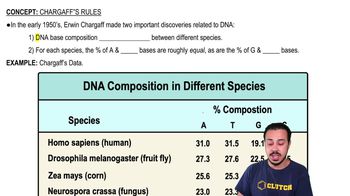
Chargaff's Data
Experimental results showing base percentages in various species, foundational for understanding DNA structure.
Technique Limitation
Experimental constraints that caused slight discrepancies in measured DNA base percentages.
 BackBack
 04:33
04:33