Chemical Methods to Control Microbial Growth quiz #1 Flashcards

Chemical Methods to Control Microbial Growth quiz #1
1 student found this helpful
Control buttons has been changed to "navigation" mode.
1/10
  • Which method of microbial control is primarily responsible for the preservation of beef jerky from microbial growth?
    The preservation of beef jerky relies on chemical methods such as the use of sanitizers or disinfectants, often combined with physical methods like dehydration and salting, to inhibit or kill microbes and prevent spoilage.
  • What is a safe and useful type of disinfectant for use on living tissue?
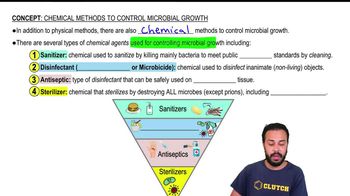
    Antiseptics are safe and useful disinfectants that can be applied to living tissue to control microbial growth without causing harm.
  • Which of the following is a chemical means of controlling microbial growth?
    Chemical means of controlling microbial growth include the use of sanitizers, disinfectants, antiseptics, and sterilizers.
  • Which two alcohols are effective in microbial control?
    Ethanol and isopropanol are two alcohols commonly used as effective chemical agents for microbial control.
  • What is the main difference between a bactericide and a bacteriostatic agent?
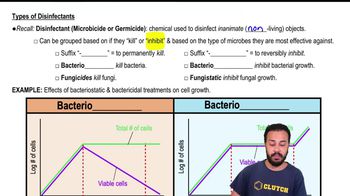
    A bactericide permanently kills bacteria, while a bacteriostatic agent only inhibits bacterial growth temporarily and allows growth to resume if removed.
  • Why is the activity of a chemical agent around organic matter an important consideration when selecting it for microbial control?
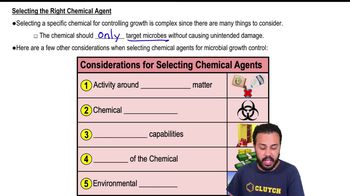
    Organic matter can interfere with the effectiveness of chemical agents, making them less able to control microbes in environments like soil.
  • What does the suffix '-cide' indicate when referring to chemical agents used for microbial control?
    The suffix '-cide' means the chemical agent permanently kills the targeted microbe, such as bacteria or fungi.
  • What is one reason why a highly effective chemical agent might not be chosen for microbial control?
    A highly effective chemical agent might not be chosen if it is too toxic to humans or the environment, or if it is prohibitively expensive.
  • Which type of chemical agent is powerful enough to destroy endospores, and what is its limitation?
    Sterilizers are powerful enough to destroy endospores, but they cannot destroy prions, which are resistant to sterilization.
  • How do fungistatic agents differ from fungicidal agents in their action against fungi?
    Fungistatic agents inhibit the growth of fungi without killing them, while fungicidal agents kill fungi permanently.