Back

Concentration Gradients and Diffusion definitions

Control buttons has been changed to "navigation" mode.
1/15
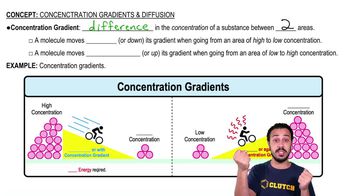
  • Concentration Gradient

    A difference in the amount of a substance between two regions, creating a directional drive for molecular movement.
  • High Concentration

    A region where a substance's molecules are densely packed compared to another area.
  • Low Concentration

    A region where a substance's molecules are sparsely distributed compared to another area.
  • Molecule

    A small particle that can move between regions of different concentrations, driving diffusion.
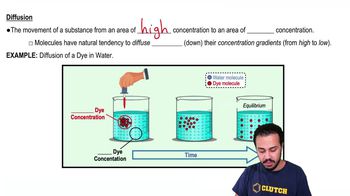
  • Diffusion

    The net movement of particles from areas of abundance to areas of scarcity, following a natural tendency.
  • Equilibrium

    A state where a substance is evenly distributed, resulting in no net movement between regions.
  • Energy Requirement

    The necessity for input to move particles from areas of scarcity to abundance, opposing natural flow.
  • Passive Transport

    A process where substances move across regions without the need for cellular energy.
  • Active Transport

    A process requiring energy to move substances from areas of low to high concentration.
  • Net Movement

    The overall directional flow of particles, considering all individual movements.
  • Distribution

    The spatial arrangement of molecules within a given area, influencing concentration gradients.
  • Substance

    Any material whose particles can undergo movement between regions of different concentrations.
  • Area

    A defined region used to compare concentrations of a substance for gradient analysis.
  • Natural Tendency

    The inherent drive of particles to move from crowded to less crowded regions without energy input.
  • Beaker

    A laboratory container used to visually demonstrate the movement and mixing of substances.