Skip to main content
Microbiology
My Course
Learn
Exam Prep
AI Tutor
Study Guides
Textbook Solutions
Flashcards
Explore
Try the app
My Course
Learn
Exam Prep
AI Tutor
Study Guides
Textbook Solutions
Flashcards
Explore
Try the app
Back
CRISPR CAS definitions
You can tap to flip the card.
CRISPR
You can tap to flip the card.
👆
CRISPR
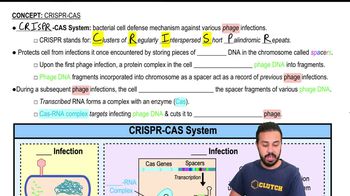
A chromosomal region in bacteria containing repeated DNA sequences interspaced with unique fragments from past phage infections.
Track progress
Control buttons has been changed to "navigation" mode.
1/15
Related flashcards
Related practice
Recommended videos
CRISPR CAS quiz
CRISPR CAS
15 Terms
CRISPR CAS
16. Microbial Genetics
4 problems
Topic
Nicole
Genome Variability
16. Microbial Genetics
4 problems
Topic
Nicole
16. Microbial Genetics - Part 1 of 2
9 topics
14 problems
Chapter
Monica
16. Microbial Genetics - Part 2 of 2
8 topics
13 problems
Chapter
Nicole
07:43
CRISPR CAS
1205
views
16
rank
1
comments
Terms in this set (15)
Hide definitions
CRISPR
A chromosomal region in bacteria containing repeated DNA sequences interspaced with unique fragments from past phage infections.
Cas
An enzyme that forms a complex with RNA to recognize and cleave foreign phage DNA, providing bacterial immunity.
Spacer
A DNA fragment derived from phages, stored in the bacterial chromosome as a genetic record of previous infections.
Phage
A virus that infects bacterial cells by injecting its genetic material, often targeted by bacterial defense systems.
Chromosome
A bacterial genetic structure where CRISPR regions and spacers are integrated, enabling inherited immunity.
Protein Complex
A group of proteins that degrades invading phage DNA into fragments for incorporation as spacers.
RNA
A molecule transcribed from spacer DNA, guiding the Cas enzyme to complementary phage DNA sequences.
Cas-RNA Complex
A molecular assembly that uses RNA guidance to locate and cleave matching phage DNA during infection.
Inherited Immunity
A protective trait passed to bacterial progeny, allowing recognition and defense against previously encountered phages.
Bacterial Defense Mechanism
A system enabling bacteria to recognize, target, and inactivate invading phage DNA using stored genetic records.
Transcription
The process of synthesizing RNA from spacer DNA, producing guide molecules for the Cas enzyme.
Cleavage
The cutting of phage DNA by the Cas-RNA complex, leading to inactivation of the invading virus.
Cas Genes
Genetic sequences encoding enzymes essential for the recognition and destruction of foreign DNA in bacteria.
Genetic Material
DNA introduced by phages into bacteria, which can be targeted and degraded by the CRISPR Cas system.
Palindromic Repeats
Short, regularly spaced DNA sequences in CRISPR regions, flanking unique spacers from phage DNA.
 BackBack
 07:43
07:43