Skip to main content
Microbiology
My Course
Learn
Exam Prep
AI Tutor
Study Guides
Textbook Solutions
Flashcards
Explore
Try the app
My Course
Learn
Exam Prep
AI Tutor
Study Guides
Textbook Solutions
Flashcards
Explore
Try the app
Back
DNA Fingerprinting definitions
You can tap to flip the card.
DNA Fingerprinting
You can tap to flip the card.
👆
DNA Fingerprinting
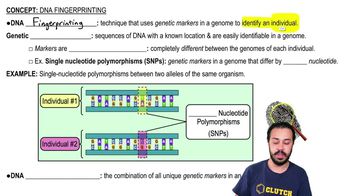
A technique using unique genetic markers in a genome to distinguish one individual from another.
Track progress
Control buttons has been changed to "navigation" mode.
1/13
Related flashcards
Related practice
Recommended videos
DNA Fingerprinting quiz
DNA Fingerprinting
15 Terms
DNA Fingerprinting
17. Biotechnology
3 problems
Topic
Nicole
Introduction to DNA Sequencing
17. Biotechnology
4 problems
Topic
Monica
17. Biotechnology
10 topics
14 problems
Chapter
Brendan
03:41
Short Tandem Repeats (STRs)
6529
views
35
rank
03:30
DNA Fingerprinting
5282
views
38
rank
Terms in this set (13)
Hide definitions
DNA Fingerprinting
A technique using unique genetic markers in a genome to distinguish one individual from another.
Genetic Marker
A DNA sequence with a known location, easily identified and variable among individuals.
Polymorphism
A difference in DNA sequence among individuals, making each genome unique.
Single Nucleotide Polymorphism
A genetic variation where a single nucleotide differs between individuals at a specific position.
SNP
A one-base difference in DNA sequence between individuals, serving as a unique identifier.
Short Tandem Repeat
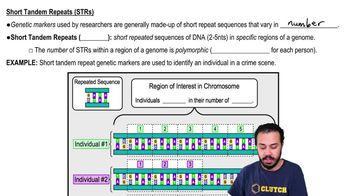
A short DNA sequence, 2 to 5 nucleotides long, repeated in a row and varying in number among individuals.
STR
A repeated DNA segment, unique in count at specific genome regions, used for individual identification.
Genome
The complete set of DNA, including all genetic information, present in an organism.
Allele
A variant form of a gene or DNA sequence found at a specific location in the genome.
Nucleotide
A building block of DNA, consisting of a base, sugar, and phosphate group.
Base Pair
Two nucleotides on opposite DNA strands that form hydrogen bonds, stabilizing the DNA structure.
Crime Scene Analysis
The application of DNA markers to match biological evidence with potential suspects.
Identification
The process of distinguishing individuals using unique genetic marker patterns.
 BackBack
 03:41
03:41