Skip to main content
Microbiology
My Course
Learn
Exam Prep
AI Tutor
Study Guides
Textbook Solutions
Flashcards
Explore
Try the app
My Course
Learn
Exam Prep
AI Tutor
Study Guides
Textbook Solutions
Flashcards
Explore
Try the app
Back
DNA Polymerases definitions
You can tap to flip the card.
DNA Polymerase
You can tap to flip the card.
👆
DNA Polymerase
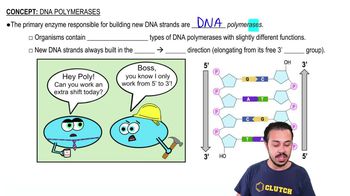
Primary enzyme responsible for building new DNA strands, always synthesizing in the 5' to 3' direction.
Track progress
Control buttons has been changed to "navigation" mode.
1/15
Related flashcards
Related practice
Recommended videos
DNA Polymerases quiz
DNA Polymerases
15 Terms
DNA Polymerases
14. DNA Replication
3 problems
Topic
Brendan
Leading & Lagging DNA Strands
14. DNA Replication
3 problems
Topic
Brendan
14. DNA Replication
10 topics
14 problems
Chapter
Brendan
03:47
DNA Polymerase Distinguishes Template from New Strand via Methylation
2396
views
25
rank
05:03
DNA Polymerases Requirements
13203
views
239
rank
04:01
DNA Polymerases
13833
views
217
rank
Terms in this set (15)
Hide definitions
DNA Polymerase
Primary enzyme responsible for building new DNA strands, always synthesizing in the 5' to 3' direction.
Enzyme
Biological catalyst, often ending in 'ase', that speeds up chemical reactions such as DNA synthesis.
Replication
Process by which a cell duplicates its DNA, ensuring genetic information is passed to new cells.
Template Strand
Existing DNA sequence that guides the addition of complementary nucleotides during synthesis.
Primer
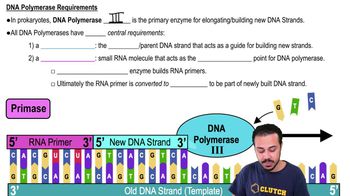
Short RNA segment providing a free 3' hydroxyl group, allowing DNA polymerase to begin elongation.
Primase
Enzyme that synthesizes the RNA primer required for DNA polymerase to initiate DNA strand synthesis.
Hydroxyl Group
Functional group (-OH) at the 3' end of a DNA strand, essential for chain elongation by DNA polymerase.
DNA Polymerase III
Main prokaryotic enzyme responsible for elongating new DNA strands during replication.
DNA Polymerase I
Enzyme that replaces RNA primers with DNA nucleotides on the newly synthesized strand.
Methylation
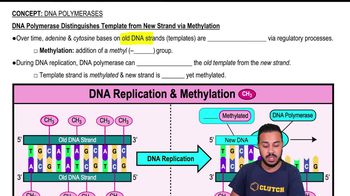
Addition of a methyl group (CH3) to DNA bases, marking old strands and aiding strand discrimination.
Nucleotide
Basic building block of DNA, consisting of a sugar, phosphate group, and nitrogenous base.
Antiparallel Strands
Orientation of DNA strands running in opposite 5' to 3' directions, enabling proper base pairing.
Base Pairing
Specific hydrogen bonding between complementary DNA bases, ensuring accurate DNA synthesis.
Phosphate Group
Chemical group attached to the 5' end of DNA, contributing to the backbone structure.
RNA Primer
Short RNA sequence synthesized by primase, providing the initial 3' end for DNA polymerase activity.
 BackBack
 03:47
03:47