Back

Endospores definitions

Control buttons has been changed to "navigation" mode.
1/15
  • Endospore

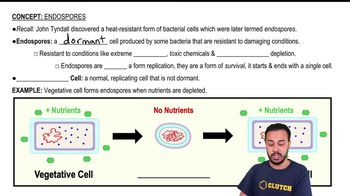
    A dormant, highly resistant bacterial cell form that enables survival in extreme heat, chemicals, or nutrient depletion.
  • Sporulation

    A process triggered by unfavorable conditions where a vegetative cell transforms into a dormant, resistant structure.
  • Vegetative Cell

    A metabolically active, replicating bacterial cell that can form a dormant structure when nutrients are scarce.
  • Germination

    A process where a dormant, resistant cell returns to an active, replicating state when conditions improve.
  • Core

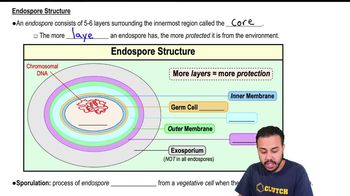
    The innermost region of a dormant bacterial structure, housing chromosomal DNA and essential cellular components.
  • Inner Membrane

    A protective layer surrounding the core, contributing to the resilience of the dormant bacterial form.
  • Germ Cell Wall

    A structural layer encasing the core, playing a role in the reactivation of the dormant bacterial form.
  • Cortex

    A thick protective layer that helps maintain dormancy and resistance to environmental stresses.
  • Outer Membrane

    A barrier layer outside the cortex, enhancing protection against harmful environmental factors.
  • Coat

    A robust protein-rich layer providing significant resistance to chemicals and physical damage.
  • Exosporium

    An optional outermost layer found in some dormant bacterial forms, offering additional environmental protection.
  • Gram-Positive Bacteria

    A group of bacteria, including Bacillus and Clostridium, known for producing highly resistant dormant forms.
  • John Tyndall

    A scientist recognized for discovering heat-resistant bacterial forms, leading to the understanding of dormancy.
  • Chromosomal DNA

    Genetic material stored within the core, preserved during dormancy for future cellular activity.
  • Nutrient Depletion

    A condition that triggers the transformation of an active bacterial cell into a dormant, resistant state.