Back

Entner-Doudoroff Pathway definitions

Control buttons has been changed to "navigation" mode.
1/13
  • Entner-Doudoroff Pathway

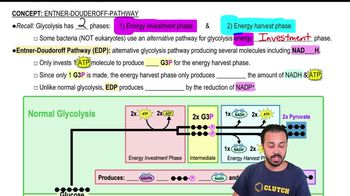
    Alternative glycolytic route in some bacteria, investing less ATP and generating NADPH, unlike the typical glycolysis used by eukaryotes.
  • Glycolysis

    Metabolic process converting glucose to pyruvate, involving energy investment and harvest phases, common in many organisms.
  • Energy Investment Phase

    Initial stage of glucose breakdown where ATP is consumed to prepare intermediates for further energy extraction.
  • Energy Harvest Phase

    Stage following energy investment, where ATP and NADH are produced from glycolytic intermediates.
  • NADPH

    Electron carrier produced in certain bacterial pathways, essential for biosynthetic reactions and not generated in standard glycolysis.
  • NADH

    Electron carrier generated during glycolysis, crucial for cellular respiration and energy production.
  • ATP

    Primary energy currency of the cell, produced and consumed during metabolic pathways like glycolysis and the Entner-Doudoroff pathway.
  • G3P

    Three-carbon intermediate formed during glycolysis and the Entner-Doudoroff pathway, feeding into energy-harvesting reactions.
  • Pyruvate

    End product of glycolytic pathways, serving as a key metabolic intermediate for further energy extraction.
  • Biosynthetic Reactions

    Cellular processes that build complex molecules, often requiring reducing power from carriers like NADPH.
  • Electron Carrier

    Molecule that temporarily holds and transfers electrons during metabolic reactions, facilitating energy conversion.
  • Alternative Pathway

    Metabolic route differing from the main process, allowing flexibility in energy extraction and biosynthesis.
  • Bacteria

    Microorganisms capable of utilizing unique metabolic pathways, such as the Entner-Doudoroff pathway, not found in eukaryotes.