Back

Enzyme Activation Energy definitions

Control buttons has been changed to "navigation" mode.
1/13
  • Activation Energy

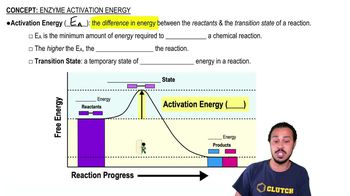
    Minimum energy difference between reactants and the transition state, dictating how quickly a reaction begins.
  • Transition State

    Temporary, high-energy condition at the peak of a reaction's energy curve, separating reactants from products.
  • Reactants

    Substances with higher initial energy that undergo transformation during a chemical reaction.
  • Products

    Substances with lower energy formed after a chemical reaction is complete.
  • Exergonic Reaction

    Process where reactants possess more energy than products, releasing energy as the reaction proceeds.
  • Endergonic Reaction

    Process requiring energy input, where products have higher energy than reactants.
  • Enzyme

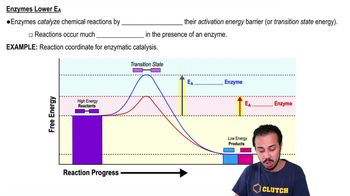
    Biological catalyst that accelerates reactions by reducing the activation energy barrier.
  • Catalysis

    Acceleration of a chemical reaction rate due to the presence of a catalyst, often an enzyme.
  • Energy Curve

    Graphical representation showing energy changes of reactants, transition state, and products during a reaction.
  • Reaction Rate

    Speed at which reactants are converted to products, influenced by the activation energy.
  • Free Energy

    Energy available to do work in a system, plotted on the y-axis of reaction progress graphs.
  • Reaction Progress

    Sequence or timeline of changes from reactants to products, often shown on the x-axis of energy graphs.
  • Energy Barrier

    Obstacle that must be overcome for reactants to reach the transition state and proceed to products.