Back

Enzyme Binding Factors definitions

Control buttons has been changed to "navigation" mode.
1/12
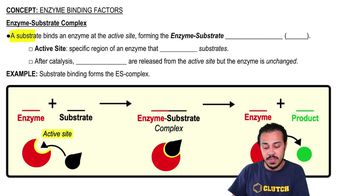
  • Active Site

    A highly specific region on an enzyme where substrates bind, enabling the chemical reaction to occur efficiently.
  • Enzyme-Substrate Complex

    A temporary molecular structure formed when a substrate fits into an enzyme's active site, allowing catalysis.
  • Substrate

    A reactant molecule that interacts with an enzyme's active site to be converted into a product.
  • Product

    A molecule released from the enzyme's active site after the substrate has been transformed during catalysis.
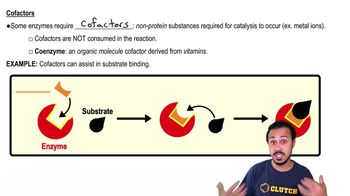
  • Cofactor

    A non-protein helper, such as a metal ion or organic molecule, required by some enzymes for catalytic activity.
  • Coenzyme

    An organic molecule, often vitamin-derived, that serves as a specific type of cofactor assisting enzyme function.
  • Metal Ion

    An inorganic cofactor, not made of amino acids, that can be essential for certain enzymes to catalyze reactions.
  • Catalysis

    The acceleration of a chemical reaction by an enzyme, which remains unchanged after the process.
  • Enzyme

    A biological catalyst, typically a protein, that speeds up reactions without being consumed or altered.
  • Reactant

    A starting molecule in a chemical reaction, such as a substrate, that undergoes transformation.
  • Vitamin

    An organic compound often serving as a precursor for coenzymes, enabling enzyme activity.
  • Amino Acid

    A building block of proteins, not present in metal ion cofactors, but fundamental to enzyme structure.