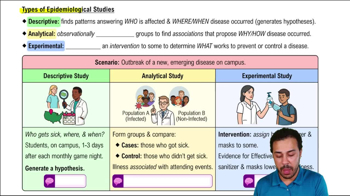
Study design focused on identifying patterns of disease by examining who, where, and when cases occur, generating hypotheses about possible risk or protective factors.
Analytical Epidemiology
Study design that tests hypotheses by comparing exposed and unexposed groups to find statistical associations, without manipulating study subjects.
Experimental Epidemiology
Study design involving assignment of interventions to groups to evaluate their effectiveness in preventing or controlling disease.
Risk Factor
Characteristic or exposure that increases the likelihood of developing a disease within a population.
Protective Factor
Characteristic or exposure that decreases the likelihood of developing a disease within a population.
Statistical Association
Relationship identified between a factor and disease occurrence, suggesting a possible link but not necessarily causation.
Control Group
Group in a study that does not receive the intervention, serving as a baseline for comparison with the experimental group.
Intervention
Action or treatment assigned to a group in a study to evaluate its effect on disease prevention or control.
Emerging Disease
Newly identified or increasing infectious condition that poses a potential threat to public health.
Hypothesis
Proposed explanation generated from observed patterns, to be tested in further studies for validity.
Exposure
Contact or interaction with a potential risk or protective factor under investigation in a study.
Case
Individual identified as having the disease or condition being studied.
Population
Group of individuals being studied to assess disease patterns, risk factors, or intervention outcomes.
Outcome
Result measured in a study, such as disease occurrence, following exposure or intervention.
Disease Occurrence
Frequency or pattern of new cases of a disease within a specified population and timeframe.