Fimbriae & Hami quiz #1 Flashcards

Fimbriae & Hami quiz #1
Control buttons has been changed to "navigation" mode.
1/10
  • Which of the following best describes the function of fimbriae in bacteria?
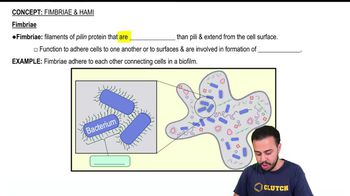
    Fimbriae are short filaments on the surface of many bacteria that help cells adhere to one another and to surfaces, playing a crucial role in biofilm formation.
  • Bacteria that lack fimbriae are less likely to do which of the following?
    Bacteria that lack fimbriae are less likely to adhere to surfaces or to each other, making them less able to form biofilms.
  • What is the main structural difference between fimbriae and pili in bacteria?
    Fimbriae are shorter filaments than pili and are composed of pilon protein, while pili are longer structures.
  • What type of cells are hammy found on, and are they present in bacteria or eukarya?
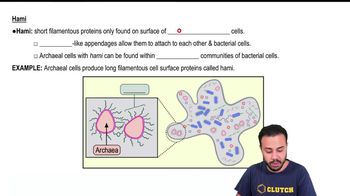
    Hammy are found only on archaeal cells and are not present in bacteria or eukarya.
  • How do hammy function to help archaeal cells within biofilms?
    Hammy act as hook-like appendages that allow archaeal cells to attach to each other and to bacterial cells, aiding biofilm formation.
  • What is the role of extracellular polymeric substance (EPS) in biofilms?
    EPS encases communities of microbes within biofilms, providing a matrix that holds the cells together.
  • Describe the appearance of fimbriae on bacterial cells as seen under magnification.
    Fimbriae appear as tiny, filamentous structures projecting from the surface of bacterial cells.
  • Can archaeal cells with hammy attach to bacterial cells, and if so, how?
    Yes, archaeal cells with hammy can attach to bacterial cells using their hook-like hammy appendages.
  • What is the significance of both fimbriae and hammy in microbial communities?
    Both fimbriae and hammy are crucial for the formation and stability of biofilms by enabling cell-to-cell and cell-to-surface attachment.
  • How do hammy differ from fimbriae in terms of their structure and function?
    Hammy are hook-like, filamentous proteins specific to archaea, functioning as grapples for attachment, while fimbriae are shorter filaments in bacteria that mediate adhesion.