Skip to main content
Microbiology
My Course
Learn
Exam Prep
AI Tutor
Study Guides
Textbook Solutions
Flashcards
Explore
Try the app
My Course
Learn
Exam Prep
AI Tutor
Study Guides
Textbook Solutions
Flashcards
Explore
Try the app
Back
Francesco Redi's Experiments definitions
You can tap to flip the card.
Francesco Redi
You can tap to flip the card.
👆
Francesco Redi
An Italian scientist from the 1600s who designed experiments that challenged the prevailing belief in spontaneous generation.
Track progress
Control buttons has been changed to "navigation" mode.
1/14
Related flashcards
Related practice
Recommended videos
Francesco Redi's Experiments quiz #1
Francesco Redi's Experiments
10 Terms
Francesco Redi's Experiments
2. Disproving Spontaneous Generation
3 problems
Topic
Brendan
Needham vs. Spallanzani
2. Disproving Spontaneous Generation
3 problems
Topic
Nicole
2. Disproving Spontaneous Generation
6 topics
11 problems
Chapter
Brendan
05:16
Francesco Redi's Experiments
3937
views
55
rank
Terms in this set (14)
Hide definitions
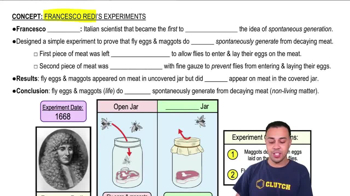
Francesco Redi
An Italian scientist from the 1600s who designed experiments that challenged the prevailing belief in spontaneous generation.
Spontaneous Generation
A historical concept proposing that living organisms could arise from nonliving matter, such as maggots from decaying meat.
Decaying Meat
Organic material used in experiments to test whether life forms like maggots could originate without external sources.
Maggots
Larval stage organisms observed on meat, whose origin was central to debates about the source of new life.
Fly Eggs
Reproductive structures deposited on meat, leading to the development of maggots when laid by adult insects.
Uncovered Jar
A container left open, allowing flies to access meat and deposit eggs, resulting in maggot development.
Covered Jar
A container sealed with fine gauze, preventing flies from reaching meat and thus stopping egg and maggot appearance.
Fine Gauze
A mesh material used to cover jars, blocking insect entry while allowing air to pass through.
Experiment
A controlled procedure involving variables like jar coverings to test the origin of maggots on meat.
Conclusion
A logical interpretation drawn from experimental results, supporting the idea that maggots originate from fly eggs.
Nonliving Matter
Substances without life, such as decaying meat, once thought to generate living organisms spontaneously.
Skepticism
A scientific attitude of doubt or questioning, especially regarding the rejection of spontaneous generation.
Life Cycle
The sequence of developmental stages, such as eggs to maggots to flies, observed in Redi's experiment.
Disproof
Evidence or reasoning that invalidates a previously accepted scientific idea, such as spontaneous generation.
 BackBack
 05:16
05:16