Skip to main content
Microbiology
My Course
Learn
Exam Prep
AI Tutor
Study Guides
Textbook Solutions
Flashcards
Explore
Try the app
My Course
Learn
Exam Prep
AI Tutor
Study Guides
Textbook Solutions
Flashcards
Explore
Try the app
Back
Genome Variability definitions
You can tap to flip the card.
Genome Variability
You can tap to flip the card.
👆
Genome Variability
Differences in DNA sequences among strains of a single species, often driven by mobile genetic elements.
Track progress
Control buttons has been changed to "navigation" mode.
1/15
Related flashcards
Related practice
Recommended videos
Genome Variability quiz
Genome Variability
15 Terms
Genome Variability
16. Microbial Genetics
4 problems
Topic
Nicole
CRISPR CAS
16. Microbial Genetics
4 problems
Topic
Nicole
16. Microbial Genetics - Part 1 of 2
9 topics
14 problems
Chapter
Monica
16. Microbial Genetics - Part 2 of 2
8 topics
13 problems
Chapter
Nicole
01:44
Phage DNA
733
views
8
rank
01:59
Genome Variability
793
views
9
rank
03:18
Genome Variability
957
views
8
rank
Terms in this set (15)
Hide definitions
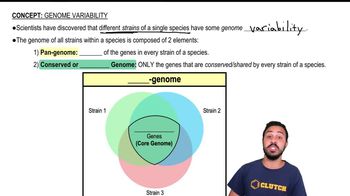
Genome Variability
Differences in DNA sequences among strains of a single species, often driven by mobile genetic elements.
Pangenome
Collection of all genes present in every strain of a species, including both shared and unique genes.
Core Genome
Set of genes consistently found in all strains of a species, representing essential genetic functions.
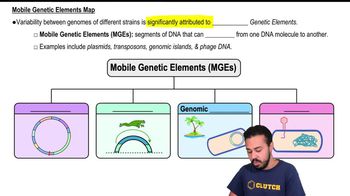
Mobile Genetic Elements
Segments of DNA capable of moving within or between genomes, contributing to genetic diversity.
Plasmid
Circular, double-stranded DNA molecule with its own origin of replication, often carrying accessory genes.
Resistance Plasmid
DNA molecule carrying genes that provide survival advantages in the presence of antibiotics.
Conjugation
Process enabling horizontal transfer of genetic material, such as plasmids, between bacterial cells.
Transposon
DNA sequence, also called a jumping gene, capable of changing its position within a genome.
Transposase
Enzyme responsible for catalyzing the movement of transposons to new genomic locations.
Insertional Inactivation
Gene disruption caused by the insertion of a mobile DNA element, leading to loss of gene function.
Genomic Island
Large chromosomal region acquired from another species, often identified by a distinct GC content.
Pathogenicity Island
Genomic segment containing genes that enhance a bacterium's ability to cause disease.
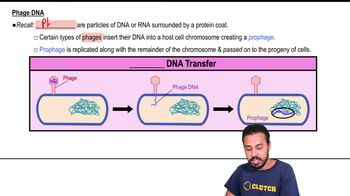
Phage DNA
Genetic material from a bacteriophage that can integrate into a bacterial chromosome as a prophage.
Prophage
Viral DNA integrated into a host genome, replicated and inherited along with the host's genetic material.
Horizontal Gene Transfer
Movement of genetic material between organisms, not by descent, often mediated by mobile elements.
 BackBack
 01:44
01:44