Gram-Positive Cell Walls quiz #1 Flashcards

Gram-Positive Cell Walls quiz #1
Control buttons has been changed to "navigation" mode.
1/10
  • All of the following are found in the cell walls of gram-positive bacteria except __________.
    Lipopolysaccharides are not found in the cell walls of gram-positive bacteria; they are characteristic of gram-negative bacteria.
  • Upon completion of the Gram stain, how will gram-positive cells appear?
    Gram-positive cells will appear purple after Gram staining due to their thick peptidoglycan layer retaining the crystal violet stain.
  • Bacterial cell walls that are resistant to drying contain which structural feature?
    A thick peptidoglycan layer, as found in gram-positive bacteria, makes the cell wall more resistant to drying.
  • Which description best describes the cell wall of a gram-positive bacterium?
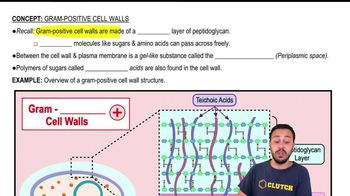
    The cell wall of a gram-positive bacterium consists of a thick peptidoglycan layer with embedded teichoic acids and a periplasmic space between the cell wall and plasma membrane.
  • Assemble the structure of a gram-positive cell wall.
    A gram-positive cell wall is composed of a thick peptidoglycan layer containing teichoic acids (wall and lipoteichoic acids), with a periplasmic space separating the cell wall from the plasma membrane.
  • What types of molecules can freely pass through the thick peptidoglycan layer of gram-positive bacteria?
    Small molecules such as sugars and amino acids can freely pass through the thick peptidoglycan layer of gram-positive bacteria.
  • What is the main chemical composition of teichoic acids found in gram-positive cell walls?
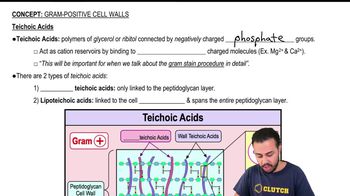
    Teichoic acids are complex polymers composed of either glycerol or ribitol molecules connected by negatively charged phosphate groups.
  • How do the negatively charged phosphate groups in teichoic acids contribute to the function of gram-positive cell walls?
    The negatively charged phosphate groups allow teichoic acids to bind positively charged ions, such as magnesium and calcium, acting as a cation reservoir.
  • What is the difference between wall teichoic acids and lipoteichoic acids in gram-positive bacteria?
    Wall teichoic acids are linked only to the peptidoglycan layer, while lipoteichoic acids are anchored to the cell membrane and span the entire peptidoglycan layer.
  • Where is the periplasmic space located in gram-positive bacteria?
    The periplasmic space is located between the thick peptidoglycan cell wall and the plasma membrane in gram-positive bacteria.