Gram-Positive vs. Gram-Negative Cell Walls quiz #1 Flashcards

Gram-Positive vs. Gram-Negative Cell Walls quiz #1
Control buttons has been changed to "navigation" mode.
1/14
  • What structural difference is found in gram-positive cells but not in gram-negative cells?
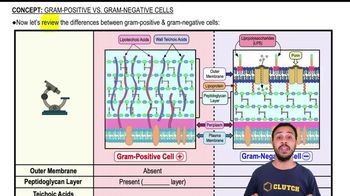
    Gram-positive cells have a thick peptidoglycan layer and teichoic acids, which are absent in gram-negative cells.
  • Which cell structure is responsible for the different results observed in the Gram stain?
    The thickness of the peptidoglycan layer in the cell wall accounts for the different results of the Gram stain.
  • Why are penicillins often more effective against gram-positive bacteria than gram-negative bacteria?
    Penicillins target peptidoglycan synthesis, and gram-positive bacteria have a much thicker peptidoglycan layer that is more accessible, while gram-negative bacteria have an outer membrane that limits drug access.
  • If you forget to use the decolorizer during the Gram stain procedure, which cell type(s) will appear purple?
    Both gram-positive and gram-negative cells will appear purple because the crystal violet is not removed from gram-negative cells.
  • Is it true that gram-positive bacteria lose the purple color and pick up the red color of safranin during Gram staining?
    No, gram-positive bacteria retain the purple color of crystal violet and do not pick up the red color of safranin.
  • The Gram stain works because of differences in the ________ of bacteria.
    The Gram stain works because of differences in the cell wall structure of bacteria.
  • The outcome of the Gram stain is based on differences in the cell's _______.
    The outcome of the Gram stain is based on differences in the cell's cell wall structure.
  • Bacteria growing on EMB agar will be Gram ______.
    Bacteria growing on EMB agar will be Gram-negative, as EMB agar inhibits Gram-positive bacteria.
  • What is the appearance of gram-positive bacteria after adding the counterstain in the Gram stain procedure?
    Gram-positive bacteria appear purple after adding the counterstain because they retain the crystal violet dye.
  • After the Gram staining procedure, gram-positive cells appear ______.
    After the Gram staining procedure, gram-positive cells appear purple.
  • During the Gram stain, which cells decolorize when the alcohol is applied?
    Gram-negative cells decolorize when the alcohol is applied.
  • The outcome of the Gram stain is based on differences in the cell's structure. What specific structure is responsible?
    The peptidoglycan layer thickness in the cell wall is responsible for the outcome of the Gram stain.
  • The Gram stain differentiates bacteria based upon structural differences of the bacterial cell wall. What are these differences?
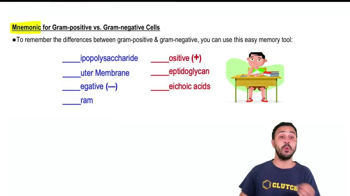
    Gram-positive bacteria have a thick peptidoglycan layer and teichoic acids, while gram-negative bacteria have a thin peptidoglycan layer, an outer membrane, and lipopolysaccharides.
  • What is found in the external covering of gram-positive cells, but not in gram-negative cells?
    Teichoic acids are found in the external covering of gram-positive cells but not in gram-negative cells.