Microbiology
My Course
Learn
Exam Prep
AI Tutor
Study Guides
Textbook Solutions
Flashcards
Explore
My Course
Learn
Exam Prep
AI Tutor
Study Guides
Textbook Solutions
Flashcards
Explore
Back
Group Translocation definitions
You can tap to flip the card.
Define:
Group Translocation
You can tap to
flip the card.
👆
Group Translocation
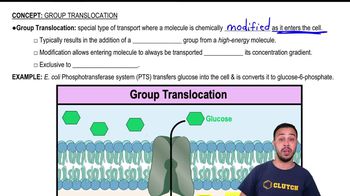
A bacterial transport process where a molecule is chemically altered during membrane passage, enabling continuous uptake.
Track progress
Control buttons has been changed to "navigation" mode.
1/13
Related practice
Recommended videos
Guided course
03:37
Group Translocation
Jason
1882
views
21
rank
Terms in this set (13)
Hide definitions
Group Translocation
A bacterial transport process where a molecule is chemically altered during membrane passage, enabling continuous uptake.
Chemical Modification
A process where an entering molecule is structurally changed, often by adding a functional group, during transport.
Phosphate Group
A chemical moiety transferred from a high-energy molecule to another molecule during transport, altering its identity.
High-Energy Molecule
A compound that donates a phosphate group to another molecule, driving the modification and transport process.
Concentration Gradient
A difference in molecule concentration across a membrane, influencing the direction of molecular movement.
Glucose-6-Phosphate
A phosphorylated form of glucose produced during entry into the cell, preventing its exit and maintaining uptake.
E. coli
A bacterial species used as a model to illustrate the phosphotransferase system in group translocation.
Phosphotransferase System
A bacterial mechanism that transports and modifies glucose by adding a phosphate group during membrane passage.
Membrane Transport
The movement of molecules across a biological barrier, which may involve chemical changes to the transported substance.
Active Transport
A cellular process requiring energy input to move molecules across membranes, sometimes involving chemical modification.
Transporter
A membrane-embedded protein complex facilitating the movement and modification of molecules during group translocation.
Bacteria
Microorganisms uniquely capable of performing group translocation for nutrient uptake.
Glucose
A sugar molecule that serves as a substrate for group translocation, undergoing phosphorylation during entry.