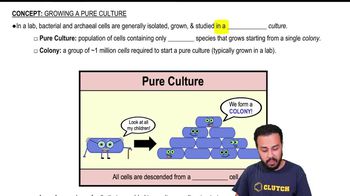
When preparing pure cultures in a microbiology lab, why is dilution necessary?
Dilution is necessary to separate individual cells so that each can grow into a single colony, ensuring that the resulting pure culture contains only one species.
What is the scientific definition of a colony in microbiology?
A colony is a group of approximately 1,000,000 cells, all of the same species, that have descended from a single cell.
Why are pure cultures important in microbiology labs?
Pure cultures are important because they allow scientists to isolate, grow, and study cells of only one species without contamination from others.
How does a single bacterial cell lead to the formation of a pure culture?
A single bacterial cell divides and replicates, producing many identical cells that form a population of only one species, resulting in a pure culture.
What is the role of an inoculum in starting a pure culture?
An inoculum, which is a colony of cells, is added to a culture medium to initiate the growth of a pure culture.
How are all cells in a pure culture related to each other?
All cells in a pure culture are descended from a single original cell, making them genetically identical.
What does the term 'culture medium' refer to in microbiology?
A culture medium is a nutrient-rich environment used to support the growth of microorganisms in the lab.
What ensures that a pure culture contains only one species?
Starting with a single cell or colony of one species and preventing contamination ensures the pure culture contains only one species.
What is the first step in creating a pure culture from a mixed sample?
The first step is to isolate a single colony that contains only one species from the mixed sample.
How does the concept of a pure culture help in studying bacterial characteristics?
Pure cultures allow researchers to study the properties and behaviors of a single species without interference from other organisms.