Skip to main content
Microbiology
My Course
Learn
Exam Prep
AI Tutor
Study Guides
Textbook Solutions
Flashcards
Explore
Try the app
My Course
Learn
Exam Prep
AI Tutor
Study Guides
Textbook Solutions
Flashcards
Explore
Try the app
Back
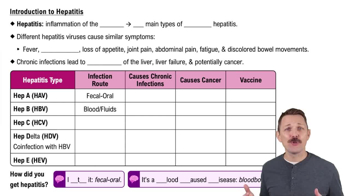
Hepatitis definitions
1 student found this helpful
You can tap to flip the card.
Hepatitis
You can tap to flip the card.
👆
Hepatitis
Liver inflammation often caused by viral infection, leading to symptoms like jaundice, fever, and abdominal pain.
Track progress
Control buttons has been changed to "navigation" mode.
1/13
Related flashcards
Related practice
Recommended videos
Hepatitis quiz
Hepatitis
15 Terms
Hepatitis
31. Microbial Infections - Digestive System
5 problems
Topic
Protozoan Diseases of the Digestive System
31. Microbial Infections - Digestive System
5 problems
Topic
31. Microbial Infections - Digestive System
5 topics
12 problems
Chapter
Guided course
02:05
Hepatitis Example 1
129
views
5
rank
Guided course
07:26
Introduction to Hepatitis
201
views
6
rank
Terms in this set (13)
Hide definitions
Hepatitis
Liver inflammation often caused by viral infection, leading to symptoms like jaundice, fever, and abdominal pain.
Jaundice
Yellowing of skin and eyes due to bilirubin buildup when the liver fails to clear this molecule efficiently.
Bilirubin
A cellular byproduct normally cleared by the liver; its accumulation causes yellow discoloration in tissues.
Cirrhosis
Scarring and death of liver tissue resulting from chronic inflammation, potentially leading to organ failure.
Hepatocellular Carcinoma
A type of liver cancer that can develop after long-term viral infection and chronic liver damage.
Fecal-Oral Contamination
Transmission route involving ingestion of pathogens from contaminated food or water, common for certain hepatitis types.
Bloodborne Pathogen
An infectious agent transmitted through blood or bodily fluids, associated with chronic viral infections.
Chronic Infection
A persistent infection that remains in the body long-term, increasing risk for severe liver complications.
Satellite Virus
A virus unable to replicate independently, requiring another virus's machinery for reproduction, as seen with hepatitis D.
Antiviral
A medication used to treat viral infections, capable of clearing certain chronic hepatitis viruses from the body.
Vaccine
A preventive medical intervention that stimulates immunity, available for some but not all hepatitis viruses.
Immunodeficiency
A weakened immune state, often due to organ transplantation or medication, increasing risk for chronic viral infections.
Coinfection
Simultaneous infection with two pathogens, such as hepatitis B and D, which can worsen disease outcomes.
 BackBack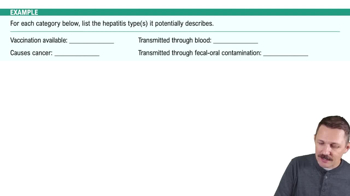
 02:05
02:05