Skip to main content
Microbiology
My Course
Learn
Exam Prep
AI Tutor
Study Guides
Textbook Solutions
Flashcards
Explore
Try the app
My Course
Learn
Exam Prep
AI Tutor
Study Guides
Textbook Solutions
Flashcards
Explore
Try the app
Back
Hydrogen Bonding definitions
You can tap to flip the card.
Hydrogen Bond
You can tap to flip the card.
👆
Hydrogen Bond
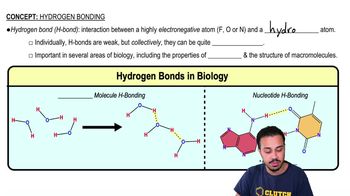
An interaction involving a hydrogen atom and a highly electronegative atom, crucial for many biological structures and properties.
Track progress
Control buttons has been changed to "navigation" mode.
1/13
Related flashcards
Related practice
Recommended videos
Hydrogen Bonding quiz
Hydrogen Bonding
15 Terms
Hydrogen Bonding
3. Chemical Principles of Microbiology
3 problems
Topic
Brendan
Ionic Bonding
3. Chemical Principles of Microbiology
3 problems
Topic
Nicole
3. Chemical Principles of Microbiology
7 topics
12 problems
Chapter
Nicole
05:03
Hydrogen Bonding
23397
views
383
rank
Terms in this set (13)
Hide definitions
Hydrogen Bond
An interaction involving a hydrogen atom and a highly electronegative atom, crucial for many biological structures and properties.
Electronegativity
A property of certain atoms, like fluorine, oxygen, and nitrogen, that enables strong attraction to electrons in bonds.
Fluorine
A highly electronegative atom capable of forming strong interactions with hydrogen in biological molecules.
Oxygen
A key atom in water and macromolecules, known for its strong attraction to hydrogen in specific molecular interactions.
Nitrogen
An atom found in nucleotides and other molecules, often forming important interactions with hydrogen atoms.
Water Molecule
A compound consisting of two hydrogens and one oxygen, whose unique properties arise from specific atomic interactions.
Macromolecule
A large biological molecule whose structure and function often depend on collective weak interactions.
Nucleotide
A building block of genetic material, capable of forming specific interactions essential for DNA structure.
DNA
A genetic material whose double-helix structure is stabilized by multiple weak interactions between its components.
FON
A mnemonic for the three atoms—fluorine, oxygen, nitrogen—that commonly participate in specific weak interactions.
Biological Process
A series of events in living organisms that often rely on collective weak interactions for proper function.
Interaction
A non-covalent association between atoms or molecules, often contributing to the stability of biological systems.
Bond Strength
A measure of how easily an association between atoms can be disrupted, varying from weak individually to strong collectively.
 BackBack
 05:03
05:03