Which of the following viruses has a membranous envelope?
Enveloped animal viruses, such as influenza virus and HIV, have a membranous envelope derived from the host cell membrane.
What is the first step of an animal virus’s life cycle?
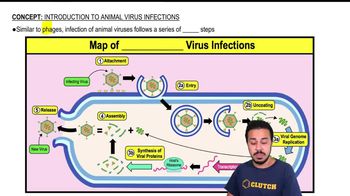
The first step of an animal virus’s life cycle is attachment, where the virus binds to specific receptors on the host cell surface.
What happens when a virus inserts its genetic material into the host cell?
When a virus inserts its genetic material into the host cell, it initiates the process of viral genome replication and synthesis of viral proteins, leading to the production of new viruses.
What is the viral process of attaching to a host cell receptor prior to infecting the cell called?
The process is called attachment, which is the initial step in the animal virus infection cycle.
Animal viruses are divided into a number of families whose names end in what suffix?
Animal virus families are named with the suffix '-viridae.'
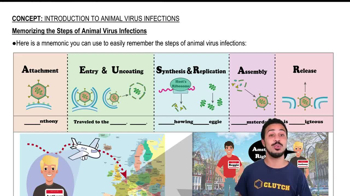
What is the purpose of the mnemonic 'Anthony traveled to the EU to show Reggie that Amsterdam is righteous' in the context of animal virus infections?
The mnemonic helps students remember the correct order of the steps in animal virus replication and infection.
After entry into the host cell, what must an animal virus do before it can replicate its genome?
The virus must undergo uncoating to release its genetic material inside the host cell.
Which step in the animal virus infection process involves the production of new viral proteins?
The synthesis step involves the production of new viral proteins.
What is the final step in the animal virus infection cycle as described in the lesson?
The final step is the release of newly produced viruses from the host cell.
How does the lesson visually represent the sequence of steps in animal virus infections?
The lesson uses a map-like image to guide students through each step of the infection process in order.