Introduction to Archaea quiz #1 Flashcards

Introduction to Archaea quiz #1
Control buttons has been changed to "navigation" mode.
1/10
  • What distinguishes archaea from animal cells?
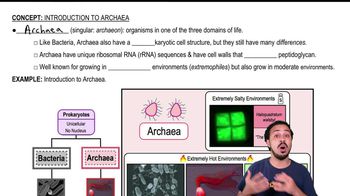
    Archaea are prokaryotic cells without a nucleus, while animal cells are eukaryotic and have a nucleus. Archaea also have unique ribosomal RNA sequences and cell walls lacking peptidoglycan, unlike animal cells.
  • If an archaebacterial species lives in a pool that is 0.01 M HCl(aq), what does this indicate about its environmental adaptation?
    This indicates that the archaebacterial species is an extremophile, adapted to survive in highly acidic environments.
  • Select all of the following that correctly describe archaeal cells.
    Archaeal cells are unicellular, prokaryotic, lack peptidoglycan in their cell walls, and can live in extreme environments.
  • Are archaea unicellular prokaryotes that live in extreme environments?
    Yes, archaea are unicellular prokaryotes, and many are extremophiles that thrive in extreme environments.
  • Are archaebacteria autotrophs or heterotrophs?
    Archaebacteria can be either autotrophs or heterotrophs, depending on the species.
  • Are archaebacteria unicellular or multicellular?
    Archaebacteria are unicellular organisms.
  • Are archaea unicellular or multicellular?
    Archaea are unicellular.
  • Are archaea autotrophs or heterotrophs?
    Archaea can be autotrophs or heterotrophs, depending on the species.
  • Is archaebacteria heterotrophic or autotrophic?
    Archaebacteria can be either heterotrophic or autotrophic, depending on the species.
  • What is the singular form of the term 'archaea'?
    The singular form of 'archaea' is 'archaeon'.