Introduction to Bacteriophage Infections quiz #1 Flashcards

Introduction to Bacteriophage Infections quiz #1
Control buttons has been changed to "navigation" mode.
1/10
  • How does a bacteriophage enter a bacterial cell?
    A bacteriophage attaches to the surface of a bacterial cell and injects its DNA into the host, leaving the protein coat outside.
  • Which of the following steps is generally not part of the life cycle of a lytic phage?
    Integration of phage DNA into the host chromosome is generally not part of the lytic phage life cycle; this occurs in lysogenic (temperate) phages.
  • All of these are steps in the lytic cycle of a temperate bacteriophage. Which happens second?
    After attachment, the second step in the lytic cycle is injection of the phage DNA into the bacterial cell.
  • When a virus infects an E. coli cell, what part of the virus enters the bacterial cytoplasm?
    Only the viral DNA (genome) enters the bacterial cytoplasm; the protein coat remains outside.
  • What is the role of bacteriophages in horizontal gene transfer?
    Bacteriophages can facilitate horizontal gene transfer between bacteria through a process called transduction, transferring genetic material from one cell to another.
  • How do filamentous phages infect bacterial cells?
    Filamentous phages infect bacterial cells by attaching to and entering through the pili of the host cell.
  • What is a lysogen in the context of bacteriophage infections?
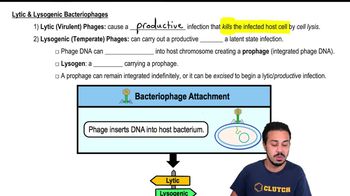
    A lysogen is a bacterial cell that carries an integrated prophage, which is phage DNA incorporated into its chromosome.
  • What can happen to the prophage during a lysogenic infection?
    The prophage can remain integrated in the host chromosome indefinitely or excise itself to initiate a lytic cycle, leading to productive infection.
  • How can integration of phage DNA during a latent state infection affect the host cell?
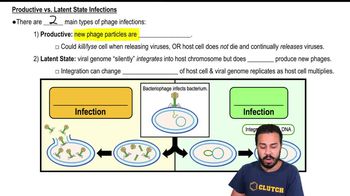
    Integration of phage DNA can change the genotype of the host cell, potentially giving it new properties.
  • What distinguishes productive infections from latent state infections in bacteriophage life cycles?
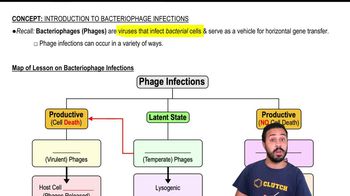
    Productive infections result in the production of new phage particles, while latent state infections involve silent integration of phage DNA without new phage production.