Which of the following is not suitable for culturing microorganisms: agar, bacteria, antigens, or antibodies?
Antigens and antibodies are not suitable for culturing microorganisms; agar is the nutrient-rich medium used for culturing, and bacteria are the organisms being cultured.
Where would you predict an obligate anaerobe would grow in a tube of fluid thioglycolate medium?
An obligate anaerobe would grow at the bottom of a tube of fluid thioglycolate medium, where oxygen concentration is lowest.
Which of the following would be the most effective method for preserving bacterial cultures?
The most effective method for preserving bacterial cultures is using aseptic technique to prevent contamination and storing cultures on solid media like agar slants or in broth under proper conditions.
What is the nutrient-rich material used to grow cells: agar, bacteria, antigens, or antibodies?
Agar is the nutrient-rich material used to grow cells in microbiology.
What is the main purpose of aseptic technique when cultivating microbes in the laboratory?
Aseptic technique is used to prevent contamination of culture media by unwanted microorganisms, ensuring only the microbes of interest are grown.
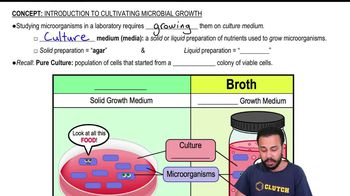
Name two physical forms that culture media can take when growing microorganisms.
Culture media can be solid, such as agar, or liquid, such as broth.
What is a pure culture in microbiology?
A pure culture is a population of cells that originated from a single colony of viable cells.
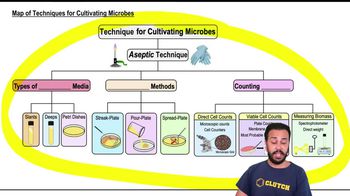
List two examples of practices included in aseptic technique.
Aseptic technique includes practices such as using a Bunsen burner and wearing gloves to prevent contamination.
What are three types of culture media mentioned in the lesson outline?
The three types of culture media are slants, deeps, and petri dishes.
Name two methods used for counting microbial cells as described in the lesson outline.
Methods for counting microbial cells include direct counts (like microscopic counts) and viable counts (such as plate counts and membrane filtration).