Why can methylene blue be used to stain DNA in DNA-based technology applications?
Methylene blue can be used to stain DNA because it binds to the negatively charged phosphate groups in the DNA molecule, allowing the DNA to be visualized during techniques such as gel electrophoresis.
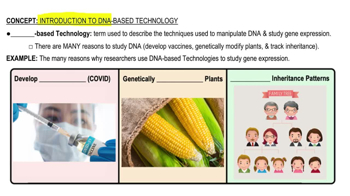
What are two major applications of DNA-based technology mentioned in the introduction video?
Two major applications are developing vaccines and genetically modifying plants for specific traits.
How can DNA-based technology help in tracking inheritance within families?
It can analyze DNA to follow inheritance patterns, often using pedigrees to visualize genetic relationships.
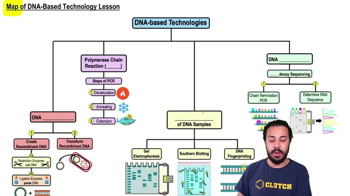
What is the first step in DNA cloning as described in the lesson?
The first step is creating recombinant DNA by cutting DNA with restriction enzymes and joining fragments with ligation enzymes.
What role do restriction enzymes play in DNA cloning?
Restriction enzymes act as molecular scissors to cut DNA at specific sequences, enabling the creation of recombinant DNA.
What is the purpose of ligation enzymes in DNA cloning?
Ligation enzymes help paste together DNA fragments to form recombinant DNA molecules.
What are the three main steps of the polymerase chain reaction (PCR) mentioned in the lesson?
The three main steps are denaturation, annealing, and extension.
Name two techniques used for the separation of DNA samples discussed in the lesson.
Gel electrophoresis and southern blotting are two techniques used for DNA separation.
What is the final section of the DNA-based technology lesson map focused on?
The final section focuses on DNA sequencing, specifically dideoxy sequencing and chain termination PCR.
How does the lesson map help students navigate the DNA-based technology course?
The map visually organizes topics and guides students through the lesson by following branches in a structured order.
 Back
Back
 03:12
03:12