Skip to main content
Microbiology
My Course
Learn
Exam Prep
AI Tutor
Study Guides
Textbook Solutions
Flashcards
Explore
Try the app
My Course
Learn
Exam Prep
AI Tutor
Study Guides
Textbook Solutions
Flashcards
Explore
Try the app
Back
Introduction to DNA Replication definitions
You can tap to flip the card.
Semi-conservative Replication
You can tap to flip the card.
👆
Semi-conservative Replication
Process where each new DNA molecule contains one parental and one newly synthesized strand, ensuring genetic continuity.
Track progress
Control buttons has been changed to "navigation" mode.
1/15
Related flashcards
Related practice
Recommended videos
Introduction to DNA Replication quiz
Introduction to DNA Replication
15 Terms
Introduction to DNA Replication
14. DNA Replication
3 problems
Topic
Brendan
DNA Polymerases
14. DNA Replication
3 problems
Topic
Brendan
14. DNA Replication
10 topics
14 problems
Chapter
Brendan
05:10
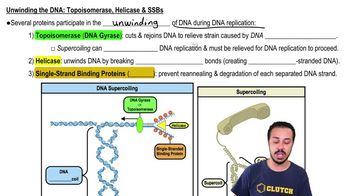
Unwinding the DNA:Topoisomerase, Helicase & SSBs
17282
views
202
rank
04:47
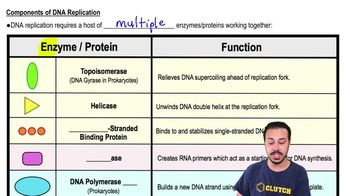
Components of DNA Replication
19660
views
277
rank
03:33
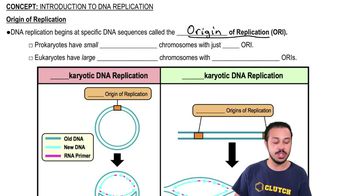
Origin of Replication
18090
views
231
rank
Terms in this set (15)
Hide definitions
Semi-conservative Replication
Process where each new DNA molecule contains one parental and one newly synthesized strand, ensuring genetic continuity.
Origin of Replication
Specific DNA sequence where duplication begins, serving as the assembly site for replication machinery.
Replication Fork
Y-shaped region formed by DNA unwinding, where new strands are synthesized in both directions.
Topoisomerase
Enzyme that relieves strain ahead of the fork by cutting and rejoining DNA, preventing supercoiling.
DNA Gyrase
Prokaryotic form of topoisomerase, crucial for removing supercoils during chromosome duplication.
Helicase
Enzyme that unwinds the double helix by breaking hydrogen bonds between complementary strands.
Single-stranded Binding Proteins
Proteins that stabilize separated DNA strands, preventing reannealing and degradation during replication.
Primase
Enzyme that synthesizes short RNA primers, providing starting points for DNA synthesis.
RNA Primer
Short nucleic acid segment synthesized by primase, required for DNA polymerase to initiate strand elongation.
DNA Polymerase III
Main prokaryotic enzyme responsible for synthesizing new DNA strands using parental templates.
DNA Polymerase I
Prokaryotic enzyme that replaces RNA primers with DNA nucleotides during replication.
DNA Ligase
Enzyme that covalently joins Okazaki fragments, sealing nicks in the lagging strand.
Okazaki Fragments
Short DNA segments synthesized discontinuously on the lagging strand during replication.
Supercoiling
Overwinding or underwinding of DNA ahead of the replication fork, which can inhibit duplication if not relieved.
Replication Bubble
Region of unwound DNA flanked by two replication forks, allowing bidirectional synthesis.
 BackBack
 05:10
05:10