Introduction to Eukaryotic Organelles quiz #1 Flashcards

Introduction to Eukaryotic Organelles quiz #1
Control buttons has been changed to "navigation" mode.
1/10
  • What are the short, hairlike structures used by eukaryotic cells for movement called?
    The short, hairlike structures used by eukaryotic cells for movement are called cilia.
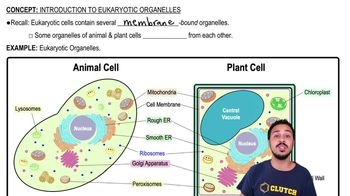
  • Which organelle is characteristic of animal cells but not typically found in plant cells?
    Lysosomes are characteristic organelles of animal cells and are not typically found in plant cells.
  • What two organelles are unique to plant cells and not commonly found in animal cells?
    Chloroplasts and cell walls are unique to plant cells and are not commonly found in animal cells.
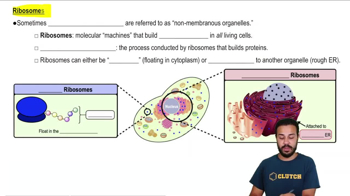
  • What is the difference between free ribosomes and attached ribosomes in eukaryotic cells?
    Free ribosomes float in the cytoplasm, while attached ribosomes are bound to the rough endoplasmic reticulum.
  • What is the sedimentation coefficient unit used to describe ribosomal subunits?
    The sedimentation coefficient unit is the Svedberg unit (S), which reflects the size of the ribosomal subunit.
  • How many ribosomal RNAs are found in the large subunit of eukaryotic ribosomes, and what are they called?
    There are three ribosomal RNAs in the large subunit: 28S, 5.8S, and 5S rRNA.
  • Which ribosomal RNA is present in the small subunit of eukaryotic ribosomes?
    The small subunit of eukaryotic ribosomes contains the 18S ribosomal RNA.
  • What is the total size of a eukaryotic ribosome, and how does it compare to a prokaryotic ribosome?
    A eukaryotic ribosome is 80S, which is larger than the 70S ribosome found in prokaryotes.
  • What organelles are shared by both animal and plant cells according to the video?
    Both animal and plant cells share mitochondria, rough and smooth ER, ribosomes, Golgi apparatus, and peroxisomes.
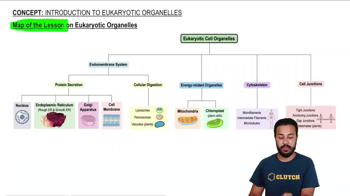
  • What is the purpose of the lesson map introduced in the video?
    The lesson map outlines the sequence of topics, starting with the endomembrane system and progressing through organelles, cytoskeleton, and cell junctions.