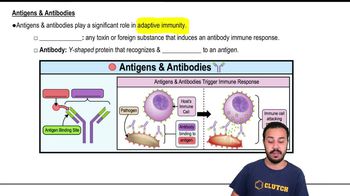
An antigen is any toxin or foreign substance, such as a microbe, that induces an immune response, specifically by triggering the production of antibodies.
What is the practice of variolation?
Variolation is the historical practice of deliberately exposing a person to material from smallpox sores to induce immunity against smallpox.
Which type of immunity becomes active as a result of infection by a specific microorganism?
Adaptive (specific) immunity becomes active as a result of infection by a specific microorganism.
What is the hallmark of a conjugated vaccine?
A conjugated vaccine contains antigens linked to carrier proteins to enhance the immune response, especially in young children.
Which medication prevents viral infections by priming the immune system against a specific virus?
A vaccine prevents viral infections by priming the immune system against a specific virus.
Which of the following is found in vaccines to evoke an immune response?
Antigens are found in vaccines to evoke an immune response.
Which antimicrobial protein triggers inflammation?
Certain complement proteins trigger inflammation as part of the immune response.
What mediates the adaptive defense system (specific defense system)?
The adaptive defense system is mediated by antibodies and adaptive immune cells such as B cells and T cells.
The specificity of an antibody is due to what?
The specificity of an antibody is due to its unique antigen-binding sites that recognize specific antigens.
Which of the complement pathways employs properdin?
The alternative complement pathway employs properdin.
Which type of immunity becomes active as a result of infection by a specific microorganism?
Adaptive (specific) immunity becomes active as a result of infection by a specific microorganism.
Which process involves antibodies cross-linking cells or particles into large aggregates?
Agglutination is the process where antibodies cross-link cells or particles into large aggregates.
A substance that stimulates an adaptive immune response is a(n) ______.
A substance that stimulates an adaptive immune response is an antigen.
Antibodies target ______ antigens.
Antibodies target specific antigens.
What are chemicals that attach to pathogens and label them as foreign bodies to be destroyed?
Antibodies are chemicals that attach to pathogens and label them as foreign bodies to be destroyed.
During inflammation, more fluid, immune cells, and proteins ______ the capillaries.
During inflammation, more fluid, immune cells, and proteins leave the capillaries.
An exposure to what protects against infection with smallpox?
An exposure to smallpox antigens, such as through variolation or vaccination, protects against infection with smallpox.
What is the initial immune response to infection according to immunology?
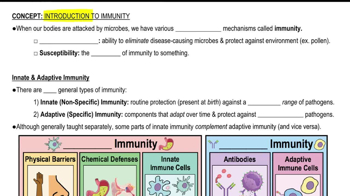
The initial immune response to infection involves innate immunity, including physical barriers, chemical defenses, and innate immune cells.
Which of the following best illustrates artificially acquired active humoral immunity?
Receiving a vaccine best illustrates artificially acquired active humoral immunity.
The antibodies found in mucus, saliva, and tears are of which class?
The antibodies found in mucus, saliva, and tears are primarily IgA.
Choose the best description of an antigen.
An antigen is a foreign substance that induces an immune response, especially the production of antibodies.
What is protection against a disease through natural defenses or vaccines called?
Protection against a disease through natural defenses or vaccines is called immunity.
Cells of the second line of defense called ______ recognize and kill virus-infected cells.
Cells of the second line of defense called natural killer (NK) cells recognize and kill virus-infected cells.
Antibodies can make it easier for phagocytes to destroy pathogens by causing the pathogens to do what?
Antibodies can make it easier for phagocytes to destroy pathogens by causing the pathogens to clump together (agglutinate) or be marked for destruction (opsonization).
Blood proteins that attack and inactivate bacteria and viruses that cause infection are called what?
Blood proteins that attack and inactivate bacteria and viruses are called complement proteins.
The complement cascade and its by-products contribute to what?
The complement cascade and its by-products contribute to inflammation, pathogen destruction, and enhanced phagocytosis.
The most abundant class of antibodies in serum is which?
The most abundant class of antibodies in serum is IgG.
The nurse is aware that the most prevalent cause of immunodeficiency worldwide is what?
Malnutrition is the most prevalent cause of immunodeficiency worldwide.
What happens if antibodies and antigens can bind together?
If antibodies and antigens bind together, it triggers an immune response that can lead to the elimination of the pathogen.