What are the barriers that prevent glucose from entering a bacterial cell from the surrounding medium?
Glucose is a large, polar molecule, so the selectively permeable bacterial membrane acts as a barrier, preventing its free diffusion. Glucose requires facilitation by specific transport proteins to cross the membrane.
Substances larger than what size are normally not allowed to pass through the filtration membrane?
Substances larger than small molecules, such as large macromolecules like polypeptides, polysaccharides, and nucleic acids, are normally not allowed to pass through the filtration membrane due to its selective permeability.
How do cationic detergents disrupt the cell membrane?
Cationic detergents disrupt the cell membrane by interacting with and destabilizing the lipid bilayer, compromising its selective permeability and leading to cell lysis.
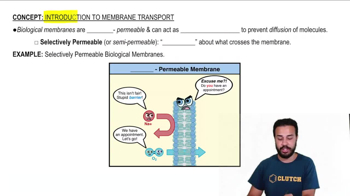
What does it mean for a biological membrane to be selectively permeable?
It means the membrane is picky about which molecules it allows to cross, only permitting certain substances based on their properties like size, charge, and polarity.
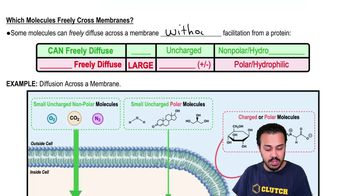
Which types of molecules can freely diffuse across a biological membrane without protein facilitation?
Small, uncharged, nonpolar, or hydrophobic molecules such as oxygen and carbon dioxide can freely diffuse across the membrane.
Why do polar molecules like water cross the membrane less easily than nonpolar molecules?
Polar molecules can cross the membrane but not as easily as nonpolar molecules because their polarity makes them less compatible with the hydrophobic core of the membrane.
What are the two major categories of membrane transport described in the lesson map?
Membrane transport is divided into molecular transport for small molecules and bulk transport for large molecules.
What is the difference between passive and active transport in terms of energy usage?
Passive transport does not require energy, while active transport requires energy input to move molecules across the membrane.
Name two types of bulk transport mechanisms mentioned in the lesson.
Endocytosis (including phagocytosis and pinocytosis) and exocytosis are two types of bulk transport mechanisms.
What feature of large macromolecules prevents them from freely diffusing across the membrane?
Their large size acts as a barrier, requiring specialized transport mechanisms to cross the membrane.