Introduction to Microbiology quiz #4 Flashcards

Introduction to Microbiology quiz #4
1 student found this helpful
Control buttons has been changed to "navigation" mode.
1/40
  • What is the most common bloodborne pathogen biohazard in the laboratory?
    Hepatitis B virus (HBV) is a common bloodborne pathogen biohazard.
  • Which of the following would be appropriate for use on animate surfaces?
    Antiseptics are appropriate for use on animate surfaces.
  • Which bird eggs are the most common choices for viral propagation?
    Chicken eggs are commonly used for viral propagation.
  • Which of these is not an acceptable way to cool food?
    Leaving food at room temperature is not an acceptable way to cool food.
  • In what/which domain(s) of life is/are microorganisms represented?
    Microorganisms are represented in all three domains: Bacteria, Archaea, and Eukarya.
  • Which of the following microorganisms actually grows inside the macrophage?
    Mycobacterium tuberculosis can grow inside macrophages.
  • What does microcurrent directly target?
    Microcurrent is not directly related to microbiology; it is used in medical therapies.
  • Which of the following factors that affect the growth of microbes can be controlled by incubators?
    Temperature is controlled by incubators to affect microbial growth.
  • One way to detect motility in the laboratory is to stab cells into what kind of medium?
    Motility test medium is used to detect microbial motility.
  • To which group would the organisms in this photo of a drop of water belong?
    Organisms in a drop of water may belong to protozoa or bacteria.
  • What beneficial effect do fungi have on blue cheese?
    Fungi contribute to the flavor and texture of blue cheese.
  • Which of the following are desirable qualities in a germicide?
    Desirable qualities include broad-spectrum activity and low toxicity.
  • Which most likely would cause diseases to be spread by polluted water?
    Fecal contamination of water can spread diseases.
  • What type of eggs must be used when serving raw or undercooked dishes to high risk populations?
    Pasteurized eggs must be used for high-risk populations.
  • Which of the following is the best example of a microbiome?
    The collection of microbes living in the human gut is a microbiome.
  • Which statement is correct concerning animal viruses?
    Animal viruses can infect and replicate within animal cells.
  • Which of the following situations might cause normal microbiota to become opportunistic pathogens?
    Immunosuppression can cause normal microbiota to become opportunistic pathogens.
  • What test is used to confirm a diagnosis of HIV?
    The Western blot test is used to confirm HIV diagnosis.
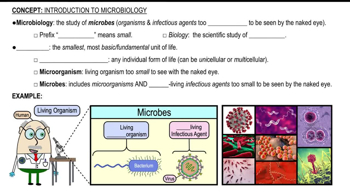
  • What is a microbe?
    A microbe is an organism or infectious agent too small to be seen with the naked eye.
  • How does an autoclave kill microorganisms?
    An autoclave kills microorganisms using high-pressure steam and heat.
  • Which highly communicable disease is considered a global health issue?
    Tuberculosis is a highly communicable global health issue.
  • Which of these best demonstrates mutualism between certain types of bacteria and humans?
    Gut bacteria synthesizing vitamins for humans is an example of mutualism.
  • What characteristic do the diseases leptospirosis and tuberculosis have in common?
    Both are caused by bacteria and can be transmitted from animals to humans.
  • A nurse practitioner suspects that a child has scarlet fever based on which assessment finding?
    A red rash and fever are key findings for scarlet fever.
  • How might the condition of a host affect how successful a pathogen is at causing disease?
    A weakened immune system increases a host's susceptibility to infection.
  • Which of the following is the most definitive means of assessing for liver disease?
    Liver biopsy is the most definitive means of assessing liver disease.
  • Which of the following are true regarding sexually transmitted infections (STIs)?
    STIs can be caused by bacteria, viruses, or other microbes and are transmitted through sexual contact.
  • Which of the following measurements is correctly matched with microorganisms of that size?
    Bacteria are typically measured in micrometers (µm).
  • Which is the most common contamination source for freshwater resources?
    Sewage is the most common contamination source for freshwater.
  • A fecal examination is used for which of the following?
    A fecal examination is used to detect intestinal parasites and microbes.
  • Which of the following is the most common type of urine sample?
    A midstream clean-catch urine sample is most common.
  • What soil properties are influenced by microorganism activity?
    Microorganisms influence soil fertility, structure, and nutrient cycling.
  • What is microbial antagonism?
    Microbial antagonism is when normal microbiota inhibit the growth of pathogens.
  • Which of the following is not a way diseases are spread?
    Vaccination is not a way diseases are spread.
  • The length of a viral multiplication cycle is usually measured in which of the following units?
    The viral multiplication cycle is measured in hours.
  • The use of an airborne infection isolation room (AIIR) falls under what hierarchal control level?
    AIIR is an example of engineering controls.
  • What can be used as an aid to count the number of colonies on a pour plate?
    A colony counter can be used to count colonies on a pour plate.
  • During malarial infection, what is observed in the blood?
    Plasmodium parasites are observed in the blood during malarial infection.
  • Why would Staphylococcus aureus intentionally bind IgG antibodies with protein A?
    Protein A helps S. aureus evade the immune system by binding IgG antibodies.
  • If a microbe lacks the basic cellular structure to reproduce, what is it classified as?
    It is classified as a virus, which is non-living and cannot reproduce independently.