What information must be recorded when performing a Polymerase Chain Reaction (PCR)?
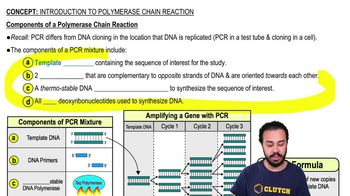
All information recorded on the PCR must include details about the template DNA, the DNA primers used, the type of thermostable DNA polymerase (such as Taq polymerase), the four deoxyribonucleotides (A, T, C, G), and the number of PCR cycles performed. Accurate documentation ensures reproducibility and proper analysis of results.
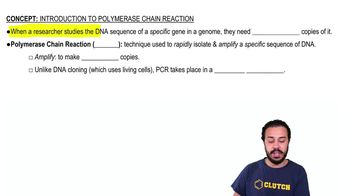
What is the main purpose of Polymerase Chain Reaction (PCR)?
The main purpose of PCR is to rapidly amplify specific DNA sequences, creating many identical copies in a test tube.
How does PCR differ from DNA cloning in terms of where the process occurs?
PCR occurs in a test tube without living cells, while DNA cloning takes place inside living cells.
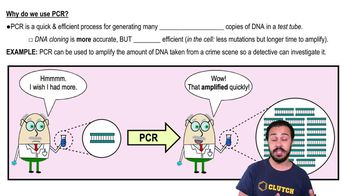
Why is PCR considered more efficient than DNA cloning?
PCR is more efficient because it can produce many DNA copies in a short time, often within 2 hours, whereas DNA cloning can take over 24 hours.
What role do DNA primers play in PCR?
DNA primers are short sequences that are complementary to the target DNA and serve as starting points for DNA synthesis during PCR.
Why is a thermostable DNA polymerase required for PCR?
A thermostable DNA polymerase, such as Taq polymerase, is needed because PCR involves high temperatures that would denature regular DNA polymerases.
What are the four deoxyribonucleotides required in a PCR mixture?
The four deoxyribonucleotides required are adenine (A), thymine (T), cytosine (C), and guanine (G).
How is the number of new DNA copies produced in PCR calculated after 'n' cycles?
The number of new DNA copies is calculated using the formula 2^n, where n is the number of PCR cycles.
In what type of real-world scenario is PCR especially useful?
PCR is especially useful in forensic investigations, such as analyzing small amounts of DNA from crime scenes.
What is the orientation of the two DNA primers used in PCR?
The two DNA primers are oriented towards each other on opposite strands, with one running 5' to 3' in one direction and the other 5' to 3' in the opposite direction.